Updated September 15, 2026 · Reviewed for pricing, product positioning and source accuracy
Replo review: is the Shopify page builder worth it in 2026?
Replo is not the cheapest way to build a Shopify landing page. Its case is stronger for ecommerce teams that care about design fidelity, fast iteration and experimentation enough to treat landing pages as a growth system rather than occasional theme edits.
Replo review: the short verdict
Replo is most compelling for Shopify teams that launch and iterate landing pages frequently enough for design speed, reusable sections and experimentation to matter economically. It is harder to justify for a small store that needs only occasional theme edits. The buying decision should therefore be based on page-production workflow and conversion experimentation, not on drag-and-drop editing alone.
- Good fit: growth teams shipping campaign pages regularly.
- Weak fit: low-volume stores with simple theme needs.
- Compare time-to-launch and developer dependence before comparing subscription price.
What Replo actually is
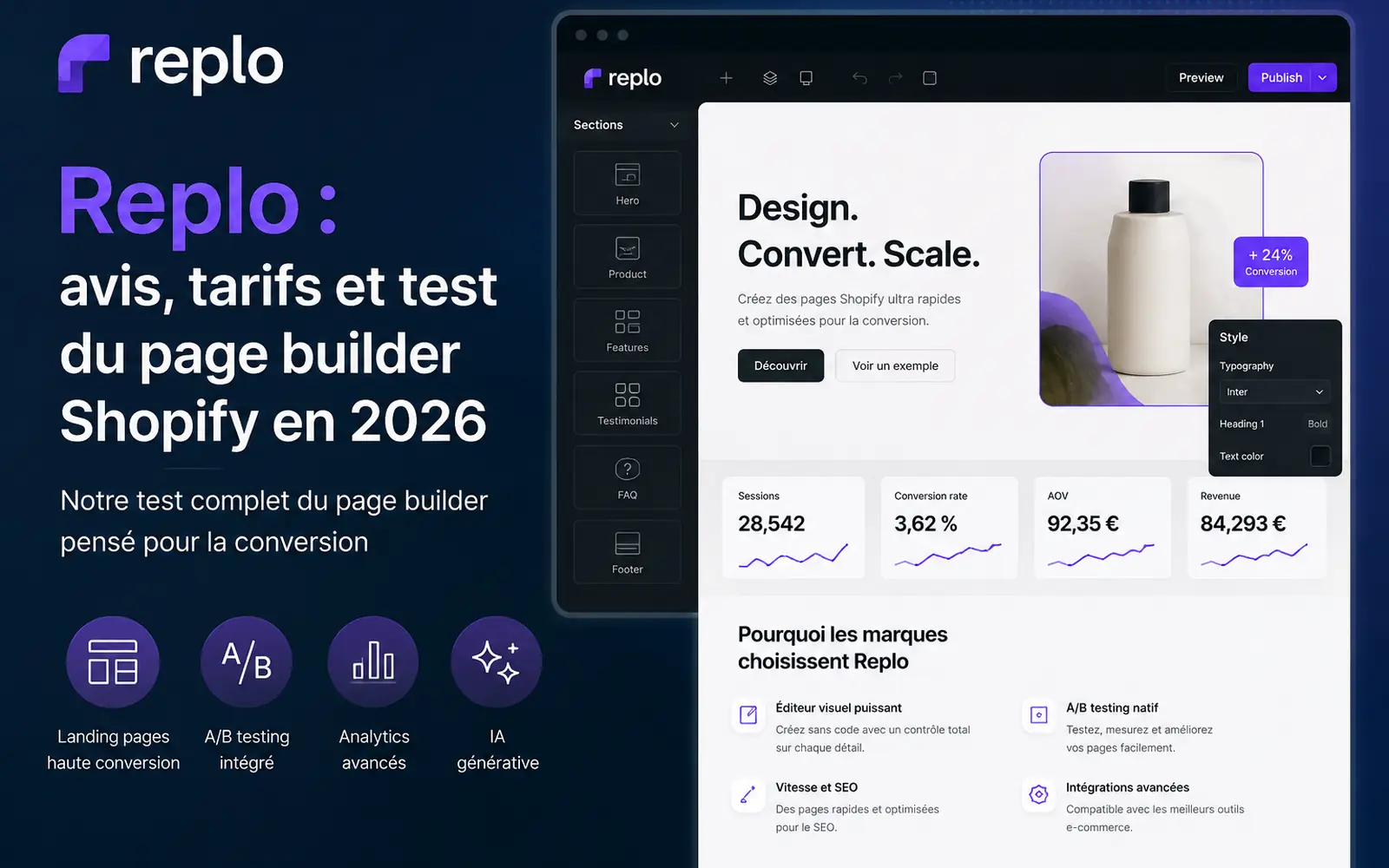
Replo is a visual Shopify page-building platform aimed at teams that want more control than the theme editor provides. The product is often used for landing pages, product pages and campaign experiences where design and conversion iteration matter.
The key distinction is workflow. If you build one static page every few months, a premium builder can be unnecessary. If marketing, design and growth teams launch pages every week, reusable components and faster iteration have much more economic value.
Visual editing and design system
Replo’s strongest appeal is the ability to create custom ecommerce layouts without turning every marketing request into a developer ticket. For a mature brand, the useful feature is not drag-and-drop by itself; it is the ability to keep repeated sections consistent while still moving quickly.
Before adopting it, recreate one existing high-performing page. This exposes the real learning curve: responsive behavior, reusable components, product data, analytics scripts and handoff between design and marketing.
AI features: helpful, but not the buying thesis
AI can accelerate first drafts, copy and page ideation, but a Shopify brand should not choose a builder because a demo can generate a page from a prompt. The generated result still needs brand review, mobile QA, product accuracy and conversion measurement.
The durable value is the combination of design workflow, Shopify data, component reuse and testing. AI is best treated as an acceleration layer inside that system.
A/B testing and analytics
Experimentation is one of the strongest reasons to look beyond a basic page builder. If a team can ship a new landing page but cannot measure whether it improves conversion, the operational speed is only half the system.
When evaluating Replo, verify how experiments are created, how traffic is split, which metrics are available and how the results connect to your analytics stack. Also check whether the experimentation feature is included in the plan you expect to buy.
SEO and performance
No page builder receives a blanket SEO pass. A page can still be slow because of large images, third-party scripts, excessive animation or a marketing stack full of tags. Test real pages with Lighthouse and field data rather than relying on a vendor claim.
For SEO, confirm that important content is present in crawlable HTML, titles and canonicals are correct, internal links work, and mobile layout does not hide or duplicate critical information.
Replo vs PageFly and GemPages
PageFly and GemPages are often easier to justify when budget is the main constraint or page-building needs are straightforward. Replo becomes more compelling as design requirements, experimentation and reusable systems become more important.
If the choice is close, run the same landing-page brief in two tools. Measure time to build, time to make mobile corrections, ease of reuse, integration friction and how quickly another teammate can edit the page safely.
Who should not buy Replo?
- A small store that only needs minor theme changes.
- A team with no process for testing or iterating pages after launch.
- A store where most conversion problems come from offer, traffic quality or checkout rather than page layout.
- A merchant that does not have time to maintain another layer in the Shopify stack.
A four-question ROI test for Replo
First, count how many meaningful landing-page changes your team ships each month. Second, estimate how much designer or developer time each change consumes today. Third, measure whether you actually run experiments after launch. Fourth, identify how many subscriptions or custom tools Replo would replace. These questions turn a subjective design preference into an operational ROI model.
A growth team that launches several paid-campaign pages every week can recover a premium subscription through speed alone. A small merchant that updates one page per quarter may not. The same software can be excellent and still be a poor purchase for a low-frequency workflow.
When you test Replo, include one page with real Shopify product data and one with your hardest responsive layout. If both can be maintained by the people who will own the page after launch, the platform is much more likely to create durable value.
Frequently asked questions
Is Replo good for Shopify?
Yes, especially for brands that need flexible landing pages, reusable design systems and experimentation. It may be excessive for very simple stores.
Is Replo better than PageFly?
Replo can be better for advanced design and growth workflows; PageFly can be a better value for broad page-building needs at a lower complexity level.
Does Replo replace a Shopify theme?
It can replace the theme editor for specific pages, but it still sits inside a broader Shopify storefront stack. Evaluate how it fits your theme and development workflow.
Sources and verification
Product capabilities and pricing can change. We prioritize first-party documentation for purchase-critical details and recommend checking the vendor before subscribing.