Updated September 15, 2026 · Reviewed for pricing, product positioning and source accuracy
Finqu review: is the ecommerce platform worth considering in 2026?
Finqu is interesting because it competes in a market dominated by much larger ecommerce platforms. The decision should therefore start with fit: what does Finqu simplify for your store, and what ecosystem depth are you giving up compared with Shopify or another established platform?
Finqu review: the short verdict
Finqu should be evaluated first as ecommerce infrastructure and only second as an AI-enabled platform. The important questions are catalog depth, checkout, payments, shipping, integrations, SEO control and day-to-day operations. AI features can reduce repetitive work, but they do not compensate for an ecosystem or integration gap that affects the core store workflow.
- Judge commerce fundamentals before AI features.
- Check required payment, shipping and integration support before migrating.
- Switching cost grows quickly once product data and SEO history accumulate.
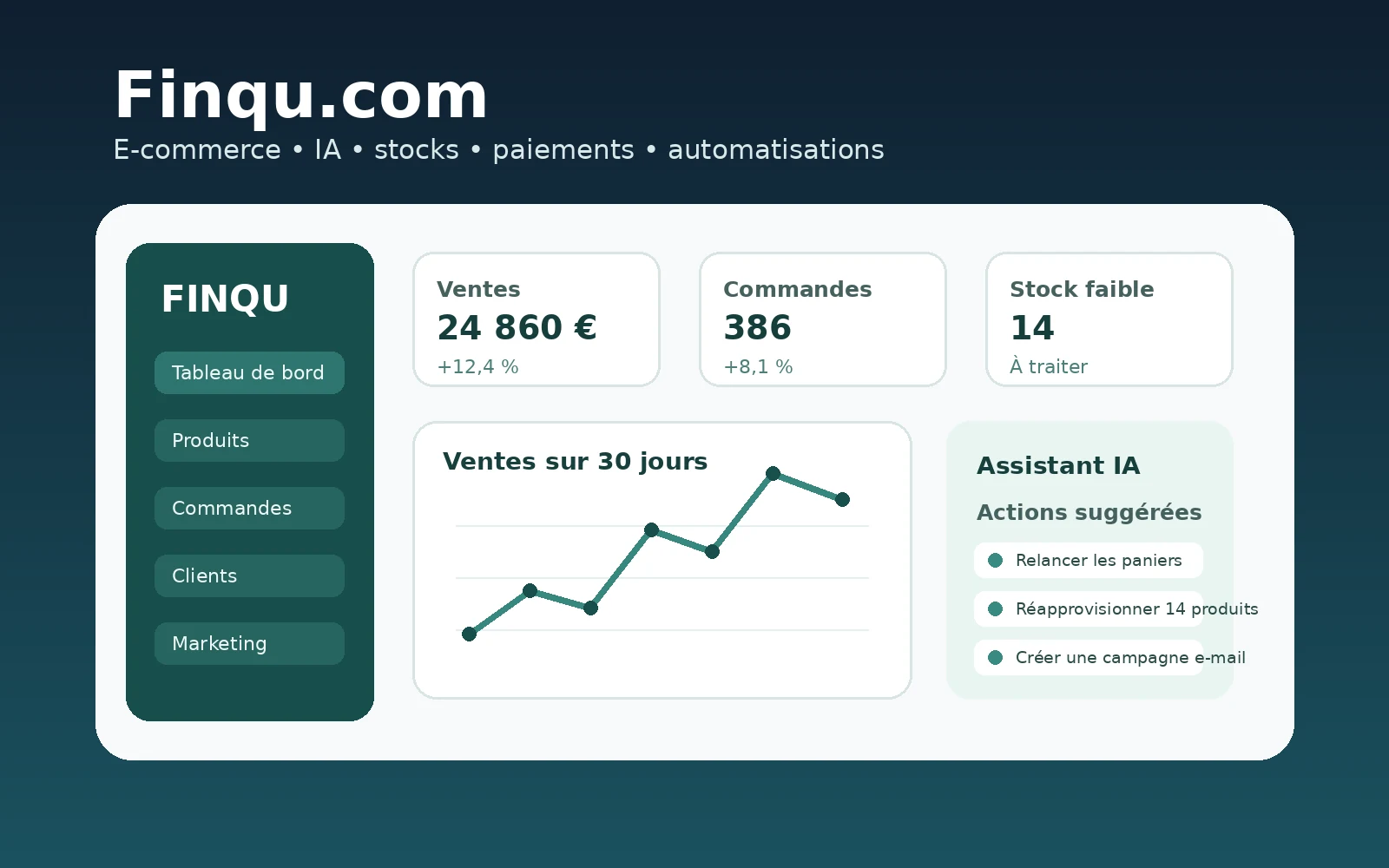
What Finqu is trying to solve
An ecommerce platform has to do far more than generate product descriptions. Catalog management, checkout, payments, shipping, order operations, promotions, analytics and integrations all matter every day. Finqu should therefore be evaluated as commerce infrastructure first and an AI-enabled product second.
This is especially important for growing merchants. The cost of switching platforms rises as product data, integrations, SEO history and operational habits accumulate.
Where AI can actually help in ecommerce
AI is most useful when it removes repetitive work: drafting product content, restructuring data, assisting customer communication or speeding up merchandising tasks. Those gains are real, but they do not compensate for a weak checkout, missing integration or operational limitation.
Test AI features with your own catalog. Generic demo products hide the hard cases: variant-heavy items, technical specifications, regulated claims, multilingual content and inconsistent supplier data.
Store operations and ecosystem
The main strategic comparison with Shopify is ecosystem depth. Shopify has a huge network of apps, agencies and integrations. A smaller platform can win by being simpler or more integrated, but you need to confirm that the services you actually use are supported.
Create a dependency list before migrating: payments, shipping carriers, accounting, email marketing, reviews, subscriptions, marketplaces, feeds, analytics and any ERP or PIM connection. A missing integration can cost more than the platform subscription.
Pricing: calculate total cost, not the headline plan
Compare monthly platform cost together with transaction fees, paid extensions, payment processing, development work and migration. An “all-in-one” product can be attractive if it removes multiple subscriptions, but only if the built-in features replace them well enough.
For a realistic comparison, model twelve months and include the cost of staff time required to maintain the stack.
Who should consider Finqu?
- Merchants evaluating alternatives to mainstream ecommerce platforms.
- Teams that prefer an integrated platform over assembling many separate apps.
- Businesses willing to verify every critical integration before migration.
- Merchants who see AI as a workflow accelerator, not the primary reason to choose commerce infrastructure.
Who should probably stay with an existing platform?
If your current store already has strong organic visibility, stable integrations and a workflow your team understands, switching platforms needs a concrete business case. “This platform has AI” is not enough. Migration risk, redirects and data continuity can outweigh a modest feature advantage.
For Shopify stores specifically, it may be easier to add specialized tools for page building or AI visibility than replace the commerce platform itself.
Migration checklist before choosing a smaller ecommerce platform
Before changing commerce infrastructure, export a complete inventory of dependencies: product variants, customer data, redirects, payment methods, tax rules, shipping rates, discount logic, reviews, analytics tags, email flows and marketplace feeds. A platform can look simpler during a demo because the complicated parts of your existing store have not been recreated yet.
Build a small staging catalog with your hardest products, not your easiest ones. Test variant combinations, out-of-stock behavior, coupons, mobile checkout, transactional email, returns and at least one real integration. Then estimate the time required to migrate the remaining catalog and preserve organic-search URLs.
A smaller platform can absolutely be the right choice, but the advantage must be operational: lower complexity, faster merchandising, better support or a meaningfully lower total cost. AI features are useful only after the commerce foundations pass this test.
Support quality is another part of platform risk that is easy to ignore during a trial. When the storefront is your revenue infrastructure, response time during checkout, payment or catalog incidents can matter more than a minor feature difference. Ask how support is delivered on your plan, what migration assistance exists and whether technical documentation is detailed enough for your team or agency to troubleshoot independently.
Questions to ask Finqu before committing
Ask for a clear answer on payment providers, shipping carriers, multilingual support, product feeds, analytics, backups, export options and what happens if you later leave the platform. Portability matters because a store is a long-lived asset, not a short campaign.
Also verify which features are native and which rely on partners or plan upgrades. An all-in-one promise is only valuable when the included capabilities replace the tools you actually use. Build a checklist from your current store rather than evaluating features in the order they appear on the sales page.
Frequently asked questions
Is Finqu an alternative to Shopify?
Yes, it can be evaluated as an ecommerce-platform alternative, but the ecosystem and integration differences are important.
Does Finqu use AI?
Finqu promotes AI-enabled ecommerce capabilities, but buyers should evaluate the core commerce workflow first and verify current AI features on the official site.
Should I migrate an existing store to Finqu?
Only after mapping critical integrations, SEO URLs, payment and shipping workflows, catalog migration and the total switching cost.
Sources and verification
Product capabilities and pricing can change. We prioritize first-party documentation for purchase-critical details and recommend checking the vendor before subscribing.