Updated September 15, 2026 · Reviewed for pricing, product positioning and source accuracy
How to create content that AI systems can cite
AI visibility is not created by adding “GEO keywords.” A page becomes easier to cite when it is accessible, specific, sourceable and structured around claims that can stand on their own. The goal is to make your page a useful source, not to write for a robot instead of a reader.
Quick answer: what makes content easier for AI systems to cite?
Citable content is accessible, specific, sourceable and easy to extract without losing context. Put a concise answer close to the relevant heading, support important claims with evidence or primary sources, define entities and metrics clearly, and make the page technically crawlable. There is no special “GEO keyword” that forces citation; the goal is to become a useful source for a question.
- Write answer-sized blocks that still make sense out of context.
- Support claims with primary evidence and explicit definitions.
- Use stable URLs, descriptive headings and clean internal linking.
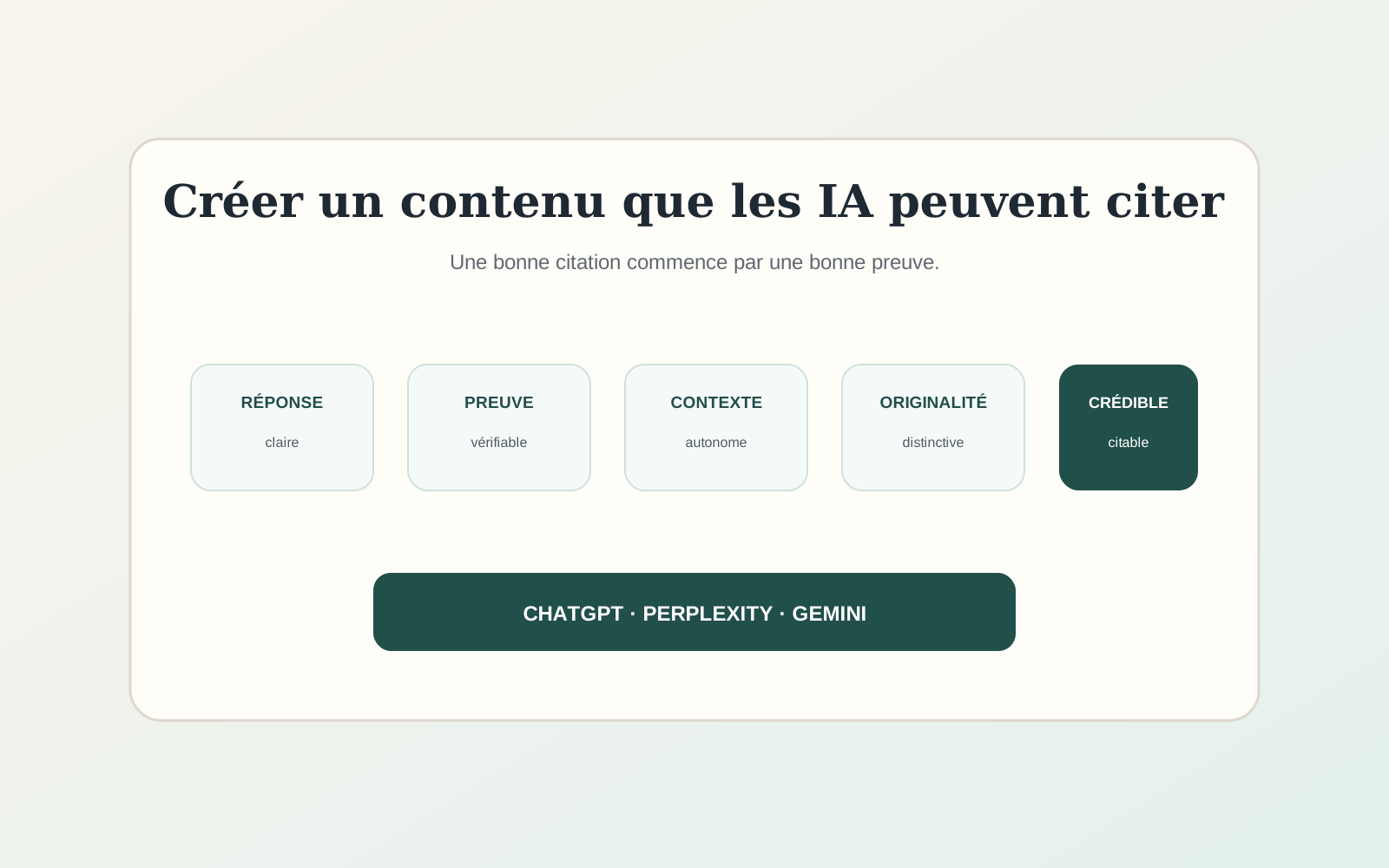
What “citable content” actually means
A citable page gives a retrieval system something concrete to use. A paragraph that says “AI is transforming business” is generic and interchangeable. A paragraph that defines a metric, explains a process, compares two options or reports an original result has much higher source value.
This does not guarantee a citation. AI systems choose sources dynamically and can answer without linking at all. The objective is to improve the probability that your page is both retrievable and useful enough to support an answer.
Write answer-sized passages
Pages often fail because the answer is spread across six paragraphs of context. For important questions, create a concise answer near the relevant heading, then expand with evidence and nuance below it.
A good answer-sized block can usually be understood outside the rest of the article. It names the subject, states the conclusion and includes the qualification that prevents the sentence from becoming misleading.
Use original evidence where possible
Original tests, screenshots, benchmarks, calculations and first-hand observations are harder to replace than a rewritten vendor description. If ten websites repeat the same pricing page, an AI system has little reason to prefer the eleventh summary.
For reviews, explain what was tested and when. For calculators, expose the formula. For comparisons, state the decision criterion. For research, publish the sample and method. These details also improve human trust.
Citations and primary sources
When a claim depends on a vendor price, API behavior, policy or technical capability, link to the first-party documentation. Secondary sources are useful for interpretation, but purchase-critical facts should be traceable to the company or standards body responsible for them.
External links do not “give away SEO.” They can make a factual page more auditable. The source should support the claim directly rather than simply mention the same topic.
Structure that helps both readers and machines
- Use descriptive headings that match real questions.
- Keep definitions and verdicts close to the heading they answer.
- Use tables for true comparisons, not decorative layout.
- Add dates when freshness materially changes the answer.
- Use internal links to connect a topic cluster without repeating the same intent on multiple pages.
- Avoid hiding essential content behind client-side interactions when a plain HTML version is possible.
What not to overvalue
GEO is still full of tactics that sound more deterministic than they are. A special schema type, llms.txt file or repeated mention of an AI brand does not create authority by itself. Technical hygiene matters, but it cannot compensate for thin, derivative content.
The same applies to excessive FAQ generation. A few precise questions are more useful than twenty variants written only to manufacture long-tail keywords.
A practical publishing workflow
Start with the decision or question the page owns. Gather first-party sources, identify what you can add that is original, write the short answer, then build supporting sections. After publication, verify indexability and monitor whether the page receives search impressions, AI referral traffic or citations in a stable test set.
If another page on your site already answers the same question, improve that page instead of creating a near-duplicate. Avoiding internal intent overlap is one of the simplest ways to keep a topic cluster understandable.
A GEO quality-control checklist before publishing
Before publishing, read the page as if you were a retrieval system that had no context about your brand. Can the page identify the entity, the question, the answer and the evidence without relying on navigation labels or marketing slogans? If not, the content may still be pleasant to read but difficult to use as a source.
Check whether every major factual claim has a clear basis. If the claim is your own observation, say what you tested. If it comes from a vendor or standards body, link the primary documentation. If it is an estimate, label the assumptions. This makes the article easier to audit and reduces the risk that a precise-looking sentence becomes misinformation.
Finally, inspect internal intent overlap. If two pages on the same domain both answer the same broad question, AI systems and search engines may have to choose between them. Consolidating overlapping pages often creates a stronger source than creating another near-duplicate article.
Frequently asked questions
Can I guarantee that ChatGPT will cite my page?
No. You can improve accessibility and source value, but you do not control which sources an AI system selects.
Does schema markup make content citable?
Schema can clarify page meaning, but it does not substitute for useful content, crawlability or authority.
Is original research necessary?
No, but original evidence is a strong differentiator because it gives the page information that cannot be reproduced by simply summarizing other sites.
Sources and verification
Product capabilities and pricing can change. We prioritize first-party documentation for purchase-critical details and recommend checking the vendor before subscribing.