Updated September 15, 2026 · Reviewed for pricing, product positioning and source accuracy
The 20 best B2B AI SaaS tools in 2026
Most “best AI tools” lists mix chatbots, tiny AI features and serious workflow software. This guide uses a stricter definition: the AI must be central to a business job, or the product must add data, integrations, execution or governance that a general-purpose chatbot cannot reproduce reliably.
Quick answer: which B2B AI SaaS is best?
There is no single best B2B AI SaaS for every company. The strongest choice is the product that owns a specific workflow, connects to the systems where the work happens and produces an operational outcome you can measure. For sales teams that may be Clay or Gong; for support, Intercom Fin; for enterprise knowledge, Glean; for AI visibility, a specialist such as Peec AI, OtterlyAI or Ranked AI may fit better.
- Choose by workflow, not by the model name behind the product.
- Prioritize integrations, review controls and measurable time saved.
- Use a general chatbot when the job is occasional and does not require system access.
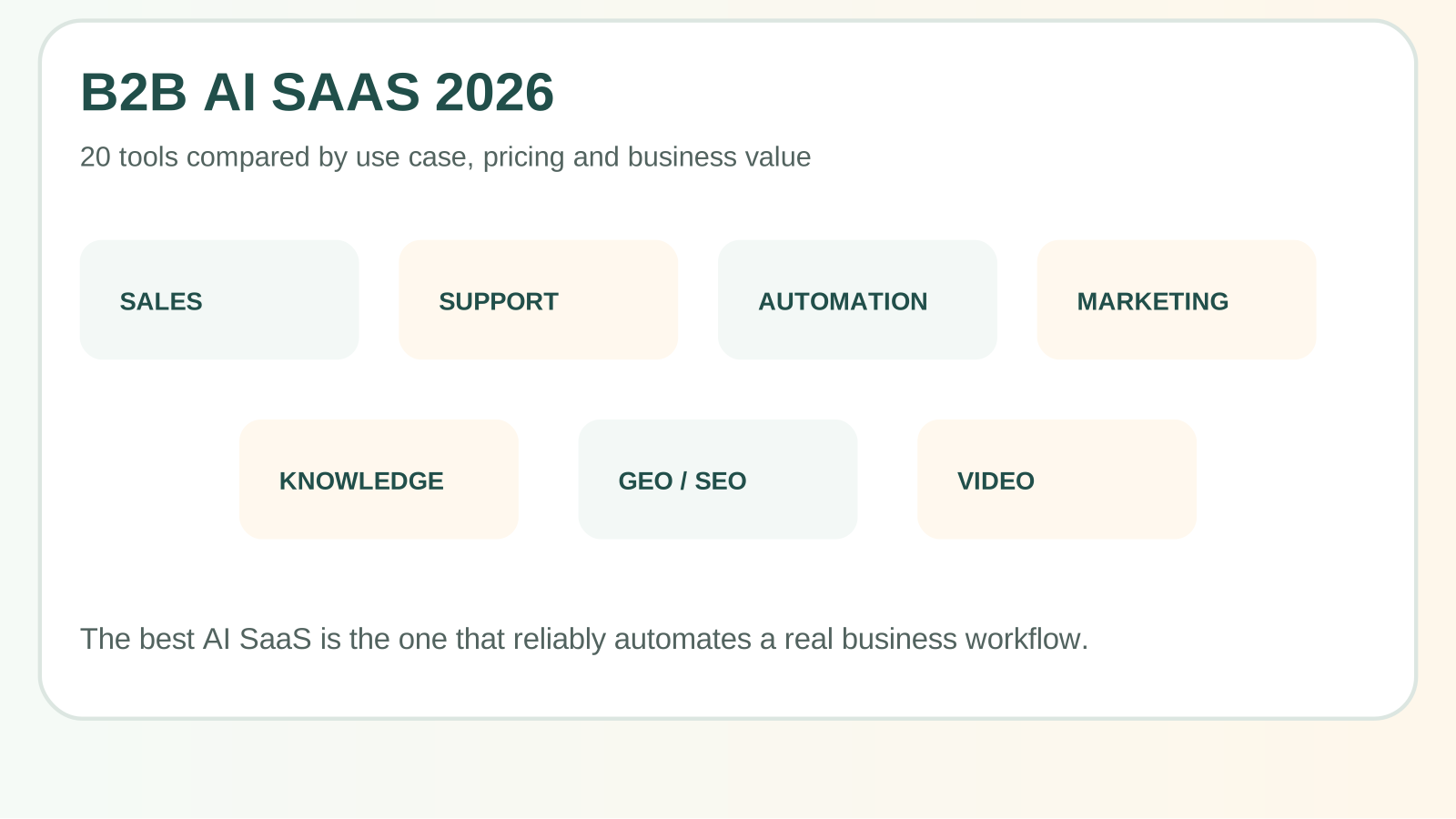
| Category | Strong options | What to evaluate |
|---|---|---|
| GTM & prospecting | Clay, Gong, Sybill, Modjo | Data quality, CRM sync, actionability, manager workflow |
| Meetings & revenue | Avoma, Fireflies.ai | Recording model, summaries, CRM field mapping, team analytics |
| Support | Intercom Fin | Resolution quality, escalation, knowledge grounding, pricing unit |
| Knowledge | Glean | Permissions, connectors, search quality, governance |
| Agents & automation | Lindy, Relevance AI | Tool access, observability, approvals, failure recovery |
| Marketing & content | Jasper, Copy.ai, WRITER | Brand controls, workflow depth, governance, reuse |
| AI visibility / GEO | Peec AI, OtterlyAI, Ranked AI | Prompt coverage, engines tracked, citation evidence, reporting |
| Video | Synthesia, Descript | Output quality, editing workflow, collaboration |
| Legal | Harvey | Security, domain depth, firm workflow, procurement |
What counts as a B2B AI SaaS?
A useful B2B AI SaaS does more than place a text generator inside a dashboard. The AI capability should either be the product’s core engine or materially change a business workflow: qualifying leads, updating a CRM, resolving support conversations, searching company knowledge, executing multi-step actions or measuring how a brand appears in AI answers.
That distinction matters because the underlying foundation model is increasingly commoditized. Two vendors may both use OpenAI, Anthropic or Google models, yet deliver very different business value because one has better data connectors, permissions, workflow state, review controls and operational reliability.
- AI-native: the product would not meaningfully exist without AI.
- AI-augmented: AI is deeply embedded in a mature workflow and changes how the work is done.
- AI feature only: a conventional SaaS with a small writing assistant or summarizer. We do not treat that alone as a reason to call the whole product an AI SaaS.
How we selected the 20 tools
We ranked products by business usefulness rather than novelty. The main criteria are workflow fit, integration depth, implementation effort, visibility into what the AI is doing, governance, pricing structure and whether the product produces an operational outcome instead of another piece of text to copy and paste.
We also ask a simple replacement question: could a capable employee reproduce most of this workflow with ChatGPT or Claude plus a spreadsheet? If the answer is yes, the specialized SaaS needs a very compelling price or user experience. If the product adds proprietary data, persistent company context, permissions, monitoring or direct execution, the subscription is easier to justify.
1–5: sales, GTM and revenue intelligence
1. Clay — GTM data and enrichment
Clay is strongest when prospecting is a data problem rather than simply an email-writing problem. Its value comes from combining enrichment sources, conditional logic and outbound workflows. The main buying question is whether your team can turn that flexibility into a maintained process rather than an over-engineered spreadsheet.
2. Gong — revenue intelligence
Gong sits higher in the enterprise revenue stack. It is not a lightweight meeting recorder: the value is conversation intelligence, coaching, pipeline context and management visibility. It makes most sense when sales leadership will actually use the data.
3. Sybill — sales admin and CRM updates
Sybill targets the work that happens after the call: summaries, CRM updates and follow-up context. That is a stronger value proposition than transcription alone when reps are losing time to sales administration.
4. Modjo — conversation intelligence
Modjo is relevant for structured revenue teams that want call intelligence and CRM-connected coaching. European buyers may also find its positioning more aligned with their operational context than a purely US-centric sales stack.
5. Avoma — meetings plus revenue workflow
Avoma combines meeting assistance with revenue-oriented workflows. It can be attractive when you want one system to cover notes, scheduling and conversation intelligence, but evaluate whether your CRM integration needs are fully met on the plan you intend to buy.
6–10: meetings, support, knowledge and agents
6. Fireflies.ai — broad meeting automation
Fireflies is a practical option for teams that need transcription, summaries and integrations without buying a heavier revenue-intelligence platform. The trade-off is that generic meeting assistants may require more configuration to reach the CRM depth of sales-specialized tools.
7. Intercom Fin — AI customer support
Fin is compelling when your support operation already lives in Intercom or when you want AI resolution tied to a mature support platform. Evaluate resolution pricing, escalation behavior, knowledge quality and the support cases you are comfortable automating.
8. Glean — enterprise knowledge
Glean’s advantage is not “chat with documents” in isolation. It is the enterprise layer around search: connectors, permissions, company context and governed access. That matters more as internal knowledge is spread across many SaaS tools.
9. Lindy — personal and operational agents
Lindy is built around agents that can participate in workflows rather than simply answer prompts. The value depends on how reliably it can use the tools your business already uses and where you place human approval steps.
10. Relevance AI — AI workforce workflows
Relevance AI targets teams building repeatable agent workflows. For buyers, the important criteria are tool connectivity, observability and how easy it is to debug an agent when a multi-step task fails.
11–15: marketing, content and AI visibility
11. Jasper
Jasper remains oriented toward marketing teams that need brand controls, repeatable content workflows and collaboration rather than one-off prompting.
12. Copy.ai
Copy.ai has moved beyond simple copy generation toward go-to-market workflows. Judge it on the specific process you want to automate, not on generic writing quality.
13. Peec AI
Peec AI belongs to the emerging category of AI-search visibility platforms. The important question is whether it tracks the engines, markets and prompt sets that matter to your brand and retains evidence for citations and recommendations.
14. OtterlyAI
OtterlyAI focuses on monitoring brand visibility in AI search. It can be useful for teams that need recurring measurements rather than manually rerunning the same prompts.
15. Ranked AI
Ranked AI is relevant when you want AI visibility work connected to a broader SEO/GEO process. As with every visibility platform, compare the reporting against your own manual test set before relying on a single score.
16–20: video, legal and enterprise content
16. Synthesia
Synthesia is a strong B2B choice for scalable presenter-style video such as training, enablement and localization. It is less relevant when the goal is cinematic production or creator-led authenticity.
17. Descript
Descript is useful when AI is embedded in an editing workflow for audio and video. Its value comes from making editing more accessible, not merely from generating text.
18. Harvey
Harvey represents vertical AI SaaS: a product built around legal workflows rather than a horizontal chatbot. That specialization can create stronger value, but procurement, security and domain-specific evaluation become more important.
19. WRITER
WRITER targets enterprise content and AI workflows with governance and company context. Buyers should evaluate deployment, model/control options and whether the platform replaces enough fragmented tooling to justify the enterprise commitment.
20. Help.center
AI knowledge-base and support products such as Help.center can be useful when the goal is to turn existing support content into self-service answers. The bottleneck is usually source quality: a weak knowledge base produces weak automated support.
How to choose without overbuying
Start with one workflow and one measurable outcome. “We need AI” is not a buying criterion. “We want every qualified sales call to create accurate CRM fields within five minutes” is. The narrower definition lets you run a pilot and compare the SaaS against your current process.
Calculate the full cost of adoption: subscription, implementation, integration maintenance, user training and human review. Then compare it with time saved, revenue gained, tickets resolved or another metric that survives outside the demo.
- Prefer a general-purpose model when the task is mostly ad-hoc drafting or reasoning.
- Prefer specialized SaaS when the job requires structured data, integrations, permissions, monitoring or direct execution.
- Avoid buying overlapping AI tools that solve the same layer of the workflow.
- For agentic products, test failure handling and approval controls, not just happy-path demos.
Frequently asked questions
What is the best B2B AI SaaS?
There is no universal winner. The best product depends on the workflow: GTM data, support, knowledge, meeting intelligence, agents, content, AI visibility or another specialized job.
Can ChatGPT replace B2B AI SaaS?
It can replace some lightweight drafting and analysis workflows. Specialized SaaS becomes more defensible when it adds proprietary data, integrations, persistent context, governance, monitoring or direct execution.
How should a small business evaluate AI SaaS?
Choose one high-friction workflow, define an outcome metric, run a short pilot and calculate the full cost including human review. Avoid buying based on the breadth of the feature list alone.
Sources and verification
Product capabilities and pricing can change. We prioritize first-party documentation for purchase-critical details and recommend checking the vendor before subscribing.
- Clay pricing
- Gong pricing
- Sybill pricing
- Avoma pricing
- Fireflies pricing
- Intercom pricing
- Glean
- Lindy pricing
- Relevance AI pricing
- Synthesia pricing