Updated September 15, 2026 · Reviewed for pricing, product positioning and source accuracy
Is an AI SaaS still profitable in 2026?
AI makes software cheaper to build in some areas and more expensive to operate in others. The critical difference from traditional SaaS is that a successful user can create a real variable model, transcription, retrieval or generation cost every time they use the product.
Quick answer: can an AI SaaS still be profitable in 2026?
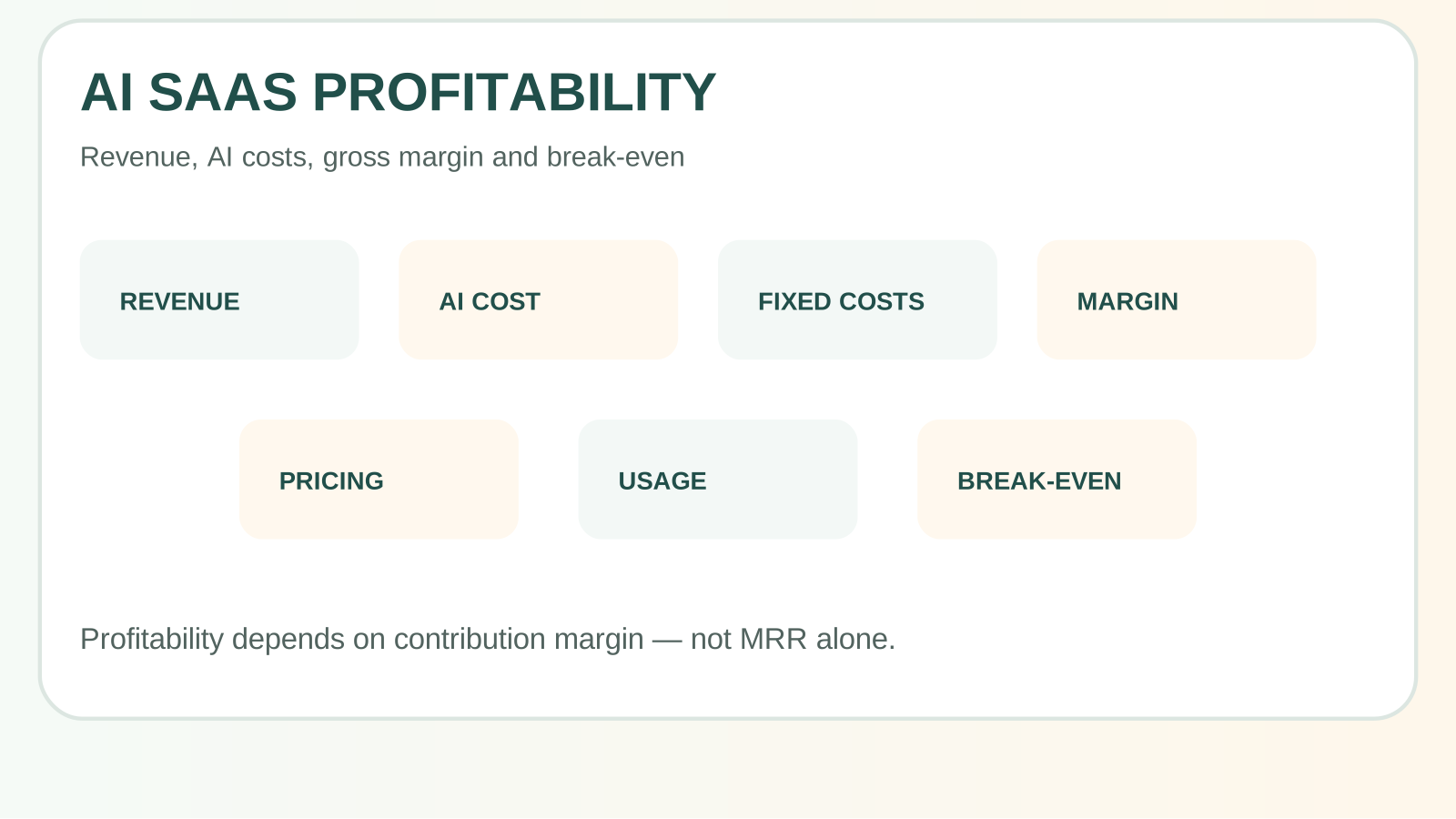
Yes — but profitability depends less on MRR alone and more on contribution margin per customer. An AI SaaS becomes fragile when model, transcription, retrieval or third-party API costs rise faster than revenue. The practical test is simple: revenue per customer minus variable AI and service costs must leave enough contribution to cover fixed costs, support, acquisition and continued product development.
- Track variable AI cost per active customer, not only total cloud spend.
- Model heavy users separately; averages can hide loss-making accounts.
- Use pricing limits, credits or usage components when consumption is highly uneven.
| Scenario at $49/mo | AI + variable cost/customer | Contribution/customer | Approx. gross contribution margin |
|---|---|---|---|
| Efficient usage | $7 | $42 | 86% |
| Moderate usage | $15 | $34 | 69% |
| Heavy usage | $30 | $19 | 39% |
The four numbers that tell you whether the SaaS works
MRR is not enough. Start with four connected numbers: revenue per customer, variable cost per customer, contribution per customer and monthly fixed costs. Contribution is the amount left after the costs that scale directly with usage. That money must then pay for engineering, support, salaries, sales, infrastructure that is not usage-linked and everything else.
Break-even customer count is a useful first approximation: divide fixed monthly costs by contribution per customer. If fixed costs are $12,000 and each customer contributes $30, you need roughly 400 customers before those fixed costs are covered. That is not the same as cash-flow break-even if you have annual contracts, refunds or large acquisition spend, but it is a clear operating baseline.
Why AI changes SaaS economics
A traditional SaaS often has infrastructure costs that grow slowly relative to revenue. An AI product may add token inference, embeddings, vector storage, transcription, reranking, image generation, video generation and third-party API charges to each customer interaction. The marginal cost is therefore more visible and, for some workloads, much higher.
The good news is that model costs can fall and routing can improve. The bad news is that users often consume more as the product becomes more useful. Treat “cost per active customer” as a live product metric, not a one-time spreadsheet assumption.
The power-user trap
Average usage can hide the customer segment that destroys margin. Imagine 100 customers where 90 cost $5 each to serve and 10 cost $60. The average variable cost is $10.50, which may look acceptable. But those ten heavy users can be deeply unprofitable under a $29 unlimited plan.
Segment usage by account, plan and workload. Look at the 50th, 90th and 99th percentile rather than only the mean. Then decide whether the product needs rate limits, credits, a higher tier, usage overages or a different architecture for expensive requests.
Which pricing model protects margin?
Flat subscriptions are easy to understand but risky when model usage is volatile. Pure usage pricing aligns revenue with cost but can make the customer’s bill unpredictable. Credits hide technical units behind a product-specific allowance, but users need to understand what a credit buys.
A hybrid model is often the most practical compromise: a base subscription captures the recurring software value, includes a sensible usage allowance and charges or upgrades customers when they materially exceed it. The important point is not to copy another AI company’s pricing page; model the behavior of your own users.
Can a simple ChatGPT wrapper still be profitable?
Yes, but profitability and defensibility are different questions. A wrapper can have excellent short-term margins if customer acquisition is cheap and usage is light. It becomes fragile when users can reproduce the core value directly in ChatGPT, Claude or Gemini, or when another founder can copy the workflow in days.
Defensibility improves when the product accumulates workflow state, proprietary data, integrations, domain logic, collaborative history, compliance controls or distribution. Those layers are not guaranteed moats, but they make the value proposition less dependent on a single prompt and model API.
What margin should you target?
There is no universal “correct” AI SaaS gross margin. A self-serve product with low support requirements can tolerate a different cost structure from a video-generation product or a deeply serviced enterprise platform. The practical question is whether your contribution margin leaves enough room to fund the rest of the company and acquire customers sustainably.
Instead of forcing a benchmark, run sensitivity tests. What happens if model costs fall 30%? What happens if average usage doubles? What if the 95th-percentile customer is five times more expensive than the median? A robust business model should survive plausible adverse cases.
Run your own numbers
Enter your price, customer count, AI cost per customer, other variable costs and fixed monthly expenses. The calculator returns MRR, contribution margin, operating result and estimated break-even customer count.
Frequently asked questions
Is AI SaaS more expensive to run than traditional SaaS?
Often, because model inference and other AI services can create material variable cost per request. The answer depends heavily on the workload and architecture.
Can unlimited AI plans be profitable?
Yes if usage is naturally bounded or cheap, but unlimited pricing becomes risky when a small number of heavy users can create large variable costs.
What is the fastest break-even formula?
A simple operating estimate is monthly fixed costs divided by contribution per customer. Contribution per customer is price minus variable cost per customer.
Sources and verification
Product capabilities and pricing can change. We prioritize first-party documentation for purchase-critical details and recommend checking the vendor before subscribing.