Updated September 27, 2026 · SmartCreatorHub
ChatGPT Ads 2026: How to Launch, Target and Measure Campaigns
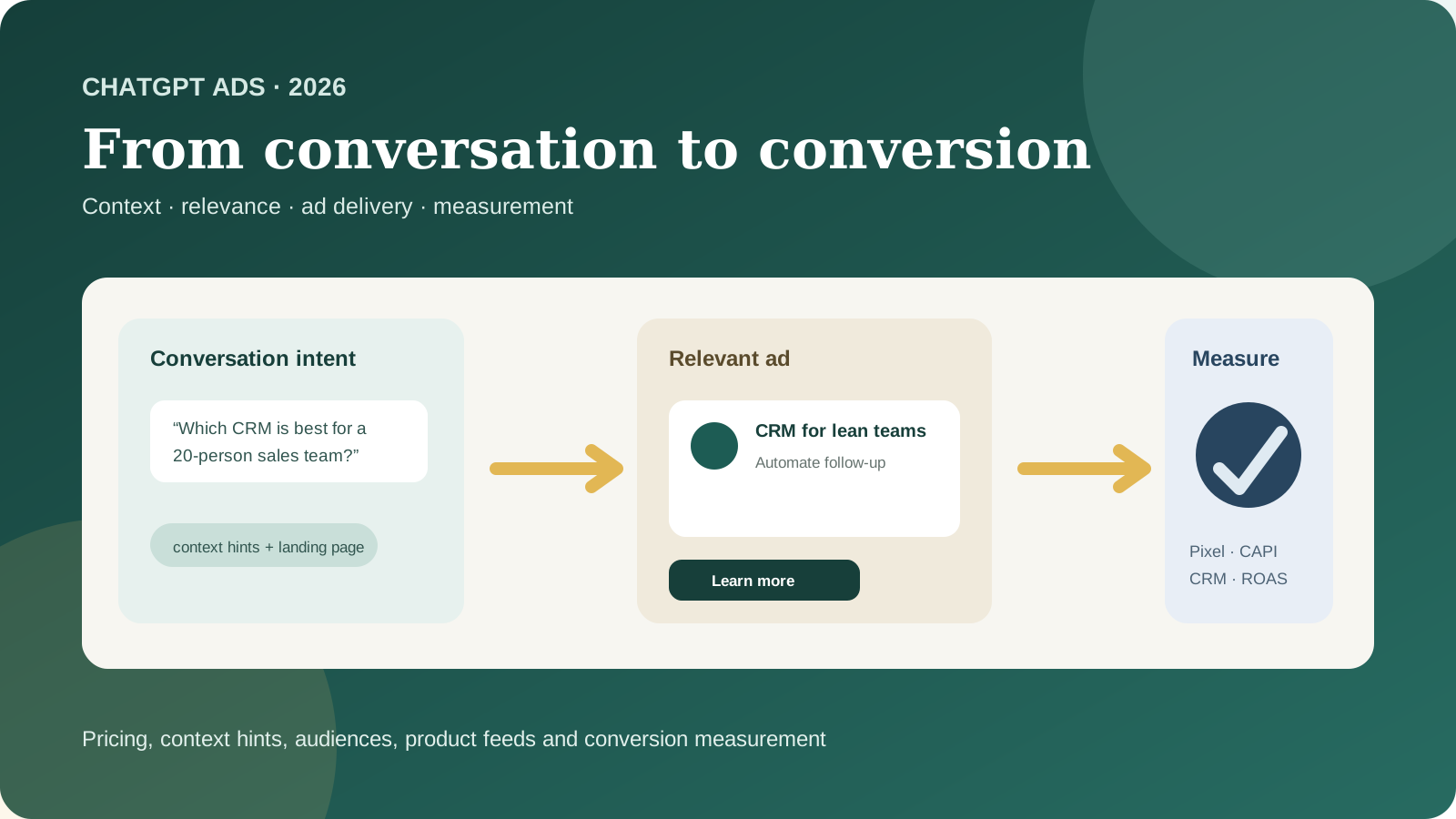
ChatGPT Ads is now a real self-serve performance channel rather than a limited pilot. Advertisers can run campaigns through Ads Manager, buy impressions or valid clicks, optimize toward conversions, use context hints to improve relevance, upload custom audiences, connect conversion data through the OpenAI Pixel or Conversions API, and launch product-feed campaigns for ecommerce.
What is ChatGPT Ads?
ChatGPT Ads is OpenAI's advertising system inside ChatGPT. Ads can appear below the end of a ChatGPT response, clearly labeled as sponsored and visually separated from the answer.
The product is designed around a different user behavior from classic search. A person may spend several turns describing a need, budget, constraints, alternatives and decision criteria before seeing an ad. That creates the possibility of matching advertising to a richer context than a single search query.
Official source: Ads in ChatGPT — the basics
Who can see ads in ChatGPT?
OpenAI currently says ads may appear to users on the Free and Go plans. Plus, Pro, Business, Enterprise and Edu accounts do not have ads. Accounts identified as belonging to users under 18 are also excluded from ad delivery.
This matters for media planning: ChatGPT's total user base is not the same thing as the addressable ad audience.
Official source: ads in ChatGPT
How ChatGPT Ads targeting actually works
ChatGPT Ads is not a traditional exact-match keyword platform. OpenAI says ad delivery considers multiple signals, including:
- context and intent of the current conversation;
- the ad landing page;
- ad title and copy;
- advertiser-provided context hints;
- eligible broader ChatGPT signals when ad personalization is enabled.
The practical implication is simple: a weak landing page or vague ad can reduce relevance even if your context hints are good.
Context hints: the most important new targeting concept
Context hints are phrases added at the ad-group level to explain when your offer may be relevant. OpenAI recommends describing what you offer, who it helps and when it is useful.
Context hints are not exact-match keywords, targeting rules or guaranteed placements. Their job is to improve the system's understanding of the offer and the situations where it may fit.
Official source: ad groups and context hints
How to structure a ChatGPT Ads campaign
| Level | Purpose | Example |
|---|---|---|
| Campaign | Objective, budget, dates, geo, platform and audiences | US lead generation |
| Ad group | One product, service, customer need or intent area | Replace an expensive CRM |
| Ad | Headline, copy, image, brand and landing page | “Simpler CRM for lean teams” |
OpenAI explicitly recommends separating meaningfully different use cases when they require different messaging or landing pages. That is more useful than creating one giant ad group containing every possible customer problem.
ChatGPT Ads pricing: CPM, CPC and conversion optimization
ChatGPT Ads supports three main campaign objectives:
| Objective | Billing | Best for |
|---|---|---|
| Views | CPM | Reach and visibility |
| Clicks | CPC | Driving traffic |
| Conversions | Conversion-optimized buying | Optimizing toward a supported business action |
A conversion campaign does not necessarily mean you pay per conversion. OpenAI supports conversion-optimized purchasing with billing options tied to clicks or impressions, depending on campaign setup and eligibility.
Official source: create campaigns
What is the minimum ChatGPT Ads budget?
For ad accounts billed in USD, the current minimum daily campaign budget is $25 per day. Minimums vary by currency: for example, EUR and GBP accounts currently show a 15-unit minimum.
That is a platform minimum, not a recommended test budget. A meaningful test must be large enough to generate enough clicks or conversions to judge whether a campaign is economically viable.
How daily budgets really work
OpenAI now treats a daily budget as an average daily amount over seven days. Daily spend can therefore be higher or lower than the value entered.
- maximum spend on a single day: up to 2× the daily budget;
- maximum spend across the applicable seven-day period: up to 7× the daily budget.
For example, a $100 daily budget can spend more than $100 on one day, but billed media spend cannot exceed $700 over the applicable seven-day period if the budget remains unchanged.
Official source: daily budgets
How much should you actually spend on a first test?
Do not start with a random number. Work backwards from the amount of data you need.
If you expect a $2 CPC and want at least 150 qualified clicks before judging the landing page, the test requires roughly $300 in media spend.
If your business needs conversions rather than clicks, work from the number of conversions required to make a decision instead.
Calculate your maximum profitable CPC
A more useful question than “What is the average ChatGPT Ads CPC?” is “What is a click worth to my business?”
Example: a SaaS company earns $200 in contribution margin from a new customer and converts 2% of paid clicks.
A $4 CPC would be the rough break-even point before additional overhead. A business that needs a 50% margin on acquisition would target materially less.
Maximize Results vs manual bids
OpenAI now offers a Maximize results bid strategy that automatically adjusts bids to generate as many selected results as possible within budget. It is the default for eligible new ad groups.
It is useful when you care more about result volume than controlling every bid. However, OpenAI notes that it does not guarantee a specific CPA, CPC or ROAS. Advertisers with hard efficiency thresholds can use manual or advanced bid controls instead.
Official source: Maximize Results
How to write ads for ChatGPT
OpenAI's own creative guidance is unusually clear: ads should be specific, useful and benefit-focused rather than relying on generic marketing language.
A good ChatGPT ad should make it obvious what the offer does, who it helps and why it matters in the current decision context.
Official source: ad creative best practices
Ad specifications you should know
For bulk campaign creation, OpenAI currently recommends:
- headline: 16–24 characters recommended, 50 maximum;
- copy: 32–48 characters recommended, 100 maximum;
- image: square PNG or JPG, up to 1200 × 1200;
- landing page: valid, reachable and not blocked by OpenAI crawlers.
Official source: campaign launch specifications
Conversion tracking: Pixel, Conversions API and attribution
ChatGPT Ads supports conversion measurement through the OpenAI Pixel, the Conversions API or both. A conversion can be reported when an eligible event is received, matches the campaign's configured conversion event, occurs within the applicable attribution window and can be connected to an eligible ad click.
For serious performance marketing, this should be configured before launch rather than added after spend begins.
Official source: conversion measurement
Custom audiences: what changed
ChatGPT Ads now supports custom audiences built from supported identifiers such as email addresses, phone numbers, hashed versions of those identifiers and Google Advertising IDs.
Advertisers can use them for:
- campaign-level inclusion;
- campaign-level exclusion;
- ad-group bid adjustments.
OpenAI currently requires at least 25,000 matched users for inclusion targeting and bid adjustments, and recommends audiences of at least 100,000 for those use cases. Smaller matched lists can still be useful for exclusions.
Official source: custom audiences
Product-feed campaigns for ecommerce
Retail advertisers can upload a catalog and create product ads at scale. Supported feed workflows include manual CSV/TXT uploads, hosted URLs and SFTP.
Product-feed ads can show structured details such as product images, titles, ratings, prices, sale prices and brand information. OpenAI says advertisers using product feeds have been among the platform's strongest performers to date. That is a platform-reported observation, not a universal benchmark.
Official source: product-feed campaigns
ChatGPT Ads for Shopify
OpenAI's Shopify app connects catalog data, inventory updates and commerce events to Ads Manager. It can sync products into a product feed and connect an OpenAI Pixel for Shopify.
Current availability matters: the dedicated Shopify integration is currently available to Shopify customers in the United States, with broader rollout planned across other ChatGPT Ads markets.
Official source: ChatGPT Ads for Shopify
ChatGPT Ads + HubSpot
The HubSpot integration is currently available to HubSpot customers wherever ChatGPT Ads is available. It can connect the ad account, create campaigns, send new leads into the CRM, trigger follow-up workflows and show performance alongside other advertising channels.
For B2B teams, this is especially valuable because it makes it easier to measure what happens after the initial click: lead quality, opportunity creation and downstream revenue.
Official source: HubSpot integration
Third-party measurement integrations
OpenAI also supports several measurement and data partners. Current documentation includes integrations with platforms such as Fospha, Hightouch, Triple Whale and WorkMagic, with additional partners documented as they become available.
This is useful for advertisers that already run multi-touch attribution, ecommerce measurement or server-side event pipelines.
Official source: measurement partner integrations
Sponsored Agents: the new ad format to watch
Sponsored Agents allow a person to open a conversation with an AI representative of a business after engaging with an ad.
However, this format is not generally available. OpenAI currently limits Sponsored Agents to selected advertisers in a limited alpha and is not accepting broad early-access requests.
Official source: Sponsored Agents
ChatGPT Ads for SaaS
SaaS advertisers should organize campaigns around buying situations rather than internal product features.
- replace a tool that is too expensive;
- compare two categories of software;
- solve one specific workflow problem;
- buy for a particular team size;
- meet a compliance, integration or budget constraint.
A context hint such as “project management software” gives the system much less information than “project management tool for 20-person agencies that need client approvals and time tracking without enterprise complexity.”
ChatGPT Ads for ecommerce
Ecommerce advertisers have two especially strong angles: product-feed campaigns and decision-stage conversations. A user may already have described desired features, price range, use case and alternatives before an ad is selected.
The best landing page is therefore often not the generic homepage. Send the user to the most specific category, product or comparison page that matches the conversation intent.
ChatGPT Ads for affiliate marketers
Affiliate campaigns can work, but platform economics are only half the problem. The affiliate program itself must allow the traffic source.
| Setup | Strength | Main risk |
|---|---|---|
| Direct affiliate link | Shortest path | Program may ban direct paid linking or brand bidding |
| Dedicated landing page | Better message match and tracking | Needs genuine value, not a thin bridge page |
| Comparison guide | Fits evaluation-stage traffic | Longer conversion path |
Always check the affiliate program's paid-media, trademark, direct-linking and attribution rules before launching.
ChatGPT Ads vs Google Search Ads
| Area | ChatGPT Ads | Google Search Ads |
|---|---|---|
| Primary intent signal | Conversation context + creative + landing page + hints | Search query + keywords + audience signals |
| User expression | Often long and detailed | Often shorter |
| Targeting concept | Context hints, audiences and controls | Keywords, audiences and mature bid systems |
| Maturity | Still developing quickly | Highly mature |
| Public benchmarks | Limited | Extensive |
ChatGPT Ads should not be treated as a replacement for Google Ads. It is a different inventory source with a different intent structure.
ChatGPT Ads vs Meta Ads
Meta is excellent at creating or stimulating demand through audience signals and creative. ChatGPT Ads is often closer to an environment where the user is already describing a problem, evaluating options or making a decision.
That makes clarity and relevance more important than interruption-style creative.
Which conversations are most valuable?
| Conversation | Commercial intent | Best ad strategy |
|---|---|---|
| “What is CRM software?” | Low | Education / awareness |
| “HubSpot vs Pipedrive for a small team?” | High | Comparison |
| “What CRM should a 20-person sales team use if Salesforce is too expensive?” | Very high | Alternative + constraint-led message |
| “I need to migrate CRM this month.” | Very high | Action-focused offer |
A practical launch framework
- Choose one primary business outcome.
- Create 2–4 ad groups around genuinely different intent areas.
- Write several specific context hints per ad group.
- Create multiple ad variations with different benefits and angles.
- Match each ad group to the most relevant landing page.
- Configure Pixel/CAPI, UTMs and CRM tracking before launch.
- Calculate your break-even CPC before spending.
- Give the test enough volume to produce a meaningful signal.
- Cut intent areas that generate clicks but no business value.
Common mistakes to avoid
- Treating context hints like exact-match keywords.
- Sending every ad group to the same homepage.
- Splitting a small budget across too many ad groups.
- Optimizing for clicks without measuring downstream conversions.
- Using an internet “average CPC” as your profitability threshold.
- Ignoring custom-audience size requirements.
- Assuming Sponsored Agents are open to every advertiser.
- Assuming the Shopify integration is already available in every market.
- Blocking OpenAI's ad crawler from the landing page.
Privacy: do advertisers see ChatGPT conversations?
No. OpenAI says conversations remain private from advertisers, ads do not influence ChatGPT's answers and advertisers cannot change or rank responses.
From an advertiser perspective, you receive campaign and conversion data rather than a transcript of the user's private conversation.
Official source: ads, answers and privacy
ChatGPT Ads FAQ
What is the minimum daily budget for ChatGPT Ads in the US?
For accounts billed in USD, OpenAI currently lists a $25 minimum daily budget.
Does ChatGPT Ads use keywords?
Not in the same way as Google Search. Context hints can mention topics or keywords, but they are not exact-match targeting rules and do not guarantee delivery in a specific conversation.
Can ChatGPT Ads optimize for conversions?
Yes. Advertisers can choose a Conversions objective and send events through the OpenAI Pixel, Conversions API or both.
Can I upload customer lists?
Yes. Custom audiences support several identifier types. Inclusion and bid-adjustment use cases currently require at least 25,000 matched users.
Can ChatGPT Ads run product ads?
Yes. Retail advertisers can create product-feed campaigns from structured catalog data.
Is the Shopify integration available in the US?
Yes. OpenAI says the dedicated ChatGPT Ads Shopify integration is currently available to Shopify customers in the United States.
Are Sponsored Agents available to everyone?
No. They are currently limited to selected advertisers in a limited alpha.
Official sources checked
- OpenAI — Ads in ChatGPT: The Basics
- OpenAI — Create Campaigns
- OpenAI — Ad Groups and Context Hints
- OpenAI — Create Ads
- OpenAI — Daily Budgets
- OpenAI — Conversion Measurement
- OpenAI — Custom Audiences
- OpenAI — Product Feeds
- OpenAI — Shopify
- OpenAI — HubSpot
- OpenAI — Sponsored Agents