Updated September 15, 2026 · Reviewed for pricing, product positioning and source accuracy
TubeAI review: is the AI YouTube tool worth using in 2026?
YouTube creators now have dozens of AI products promising ideas, scripts, optimization and automation. TubeAI should therefore be judged on workflow fit: what part of the creator process becomes faster or better, and does that improvement justify another tool in the stack?
TubeAI review: the short verdict
TubeAI makes the most sense when it removes repeated friction from idea generation, research or script preparation for YouTube. It is less compelling when the real bottleneck is editing, thumbnail testing or channel analytics. As with any specialist AI product, the question is whether YouTube-specific workflow and context save enough repeated effort to beat a general chatbot.
- Buy for workflow specialization, not just AI text generation.
- Match the tool to the stage where your channel actually loses time.
- Test output quality on your niche before committing to a long subscription.
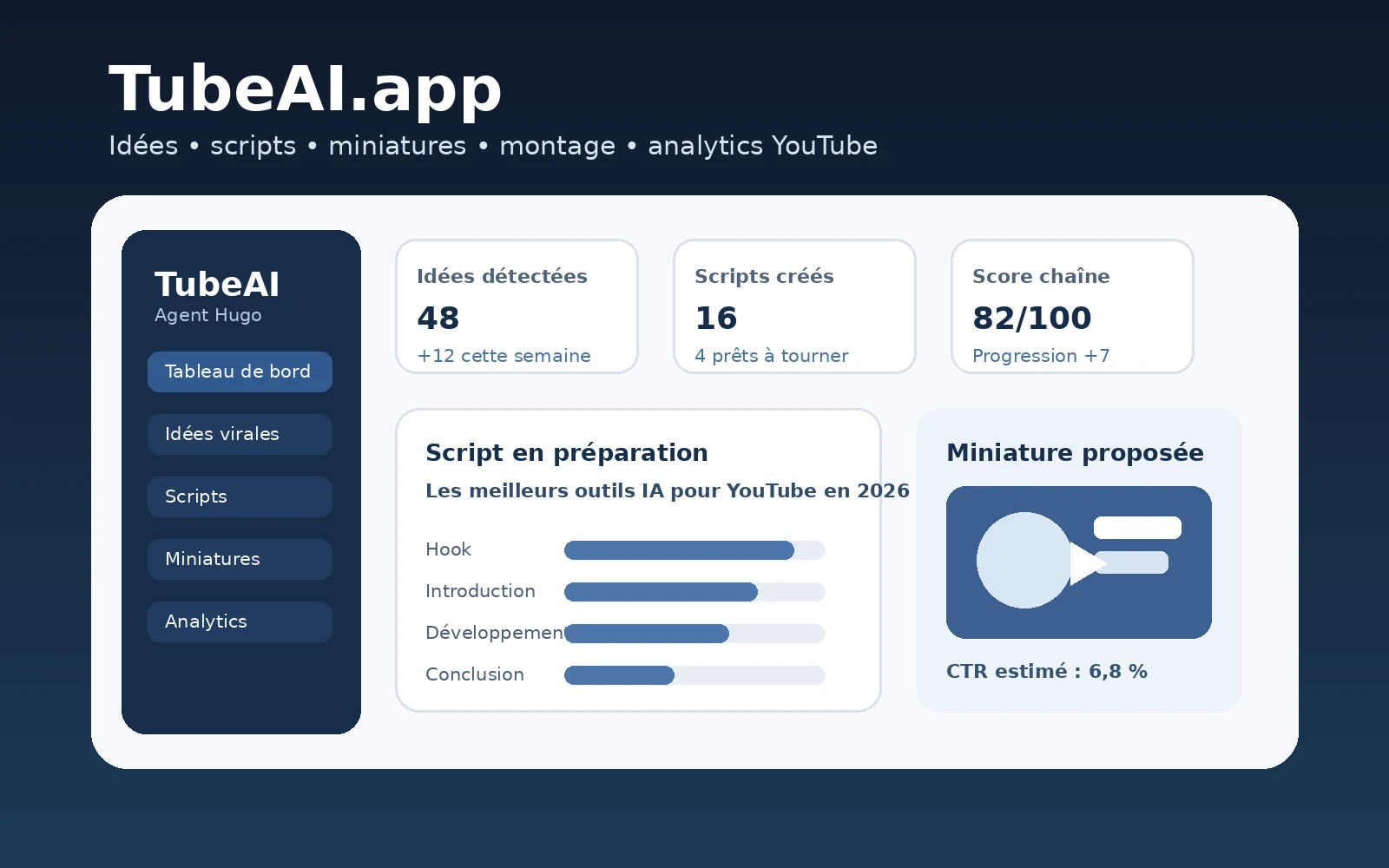
Where TubeAI fits in the creator stack
A YouTube workflow includes research, topic selection, scripting, recording, editing, packaging, publishing and post-publication analysis. No single AI feature is equally valuable at every stage.
TubeAI is easiest to justify when it removes friction from the early creative workflow and keeps context tied to YouTube tasks. If your bottleneck is editing or thumbnail testing, another category may be a better investment.
The specialized-tool test
Any dedicated AI tool now competes with general-purpose models that improve rapidly. A specialized product therefore needs to provide workflow, context, templates, data or automation that saves repeated prompting.
Run the same task in TubeAI and your existing AI assistant. Compare time to a usable result, the number of corrections, the quality of YouTube-specific structure and whether the tool helps you maintain a repeatable process across videos.
Ideas and scripts are not the same as strategy
AI can generate endless ideas. The hard part is selecting the idea that fits your audience, channel history and production capability. Treat generated topics as candidates that still need evidence from audience demand and competitive context.
The same applies to scripts. A coherent draft is useful, but your voice, examples and claims need editorial control.
When TubeAI can save time
- Turning a broad topic into multiple angles.
- Creating a structured outline before deeper research.
- Generating draft titles or hook variations to workshop.
- Maintaining a repeatable pre-production process across a team.
When another tool is a better fit
If you need keyword research, competitor analytics and channel optimization, vidIQ or TubeBuddy may be closer to the problem. If you need a deep long-form scripting environment, compare Subscribr. If you need editing, look at products such as Descript.
This category-based approach prevents the common mistake of paying for three AI products that all generate slightly different versions of the same text.
A simple way to decide whether TubeAI deserves a place in your stack
List the AI tasks you already perform each week: brainstorming, research, outline, script, titles, descriptions and repurposing. For each task, write down the current tool and approximate time. Then run the same workflow through TubeAI for several videos. The product should remove steps, not simply move them into another dashboard.
Pay particular attention to context reuse. A specialized YouTube tool becomes more valuable when it remembers channel positioning, recurring formats or audience constraints without forcing you to repeat them in every prompt. If it behaves like a generic chat window with templates, the switching cost from your existing AI assistant is much harder to justify.
Finally, avoid stacking overlapping subscriptions. A creator using TubeAI, Subscribr, vidIQ and a general-purpose model should be able to explain the distinct job of each product. If two tools mainly generate ideas and scripts, consolidate before adding another bill.
A practical buying threshold is publishing frequency. If you create one video every few months, the subscription has very little time-saving surface area. If you publish several times per week and every project repeats the same research, ideation and scripting steps, even a modest reduction in preparation time can compound. Estimate saved minutes per video and multiply by your monthly output before deciding that another AI subscription is cheap or expensive.
TubeAI vs a general-purpose AI assistant
The fairest comparison is not feature count but prompt overhead. In ChatGPT or Claude, you may need to re-explain your channel, audience, format and preferred structure for each project. A dedicated product earns its place if it stores that context and turns a recurring sequence of prompts into a repeatable workflow.
On the other hand, general-purpose assistants are stronger when your research crosses many domains, you need flexible reasoning, or you already have custom prompts and project memory that match your channel. In that case, TubeAI needs to save enough operational time to offset the cost of maintaining another workspace.
Try both approaches on three real videos. Record how many minutes it takes to reach a usable outline, how many factual corrections are required, and how much of the final script survives editing. That is a better buying signal than a feature checklist.
Frequently asked questions
Is TubeAI a replacement for vidIQ?
Not necessarily. They can address different stages of the workflow; compare the exact feature you need rather than the “AI for YouTube” label.
Can ChatGPT replace TubeAI?
For some users, yes. TubeAI has to justify itself through a more focused workflow, context or convenience.
Who should test TubeAI?
Creators who publish consistently and want a dedicated YouTube-focused AI workflow are the clearest fit.
Sources and verification
Product capabilities and pricing can change. We prioritize first-party documentation for purchase-critical details and recommend checking the vendor before subscribing.