Updated September 15, 2026 · Reviewed for pricing, product positioning and source accuracy
Ranked AI review: SEO and AI visibility in 2026
Ranked AI sits at the intersection of traditional SEO and the newer problem of visibility inside AI answer engines. That makes the product interesting, but also easy to misunderstand: no platform can guarantee that ChatGPT, Gemini or Perplexity will cite your site. The value has to come from measurement, workflow and execution.
Ranked AI review: the short verdict
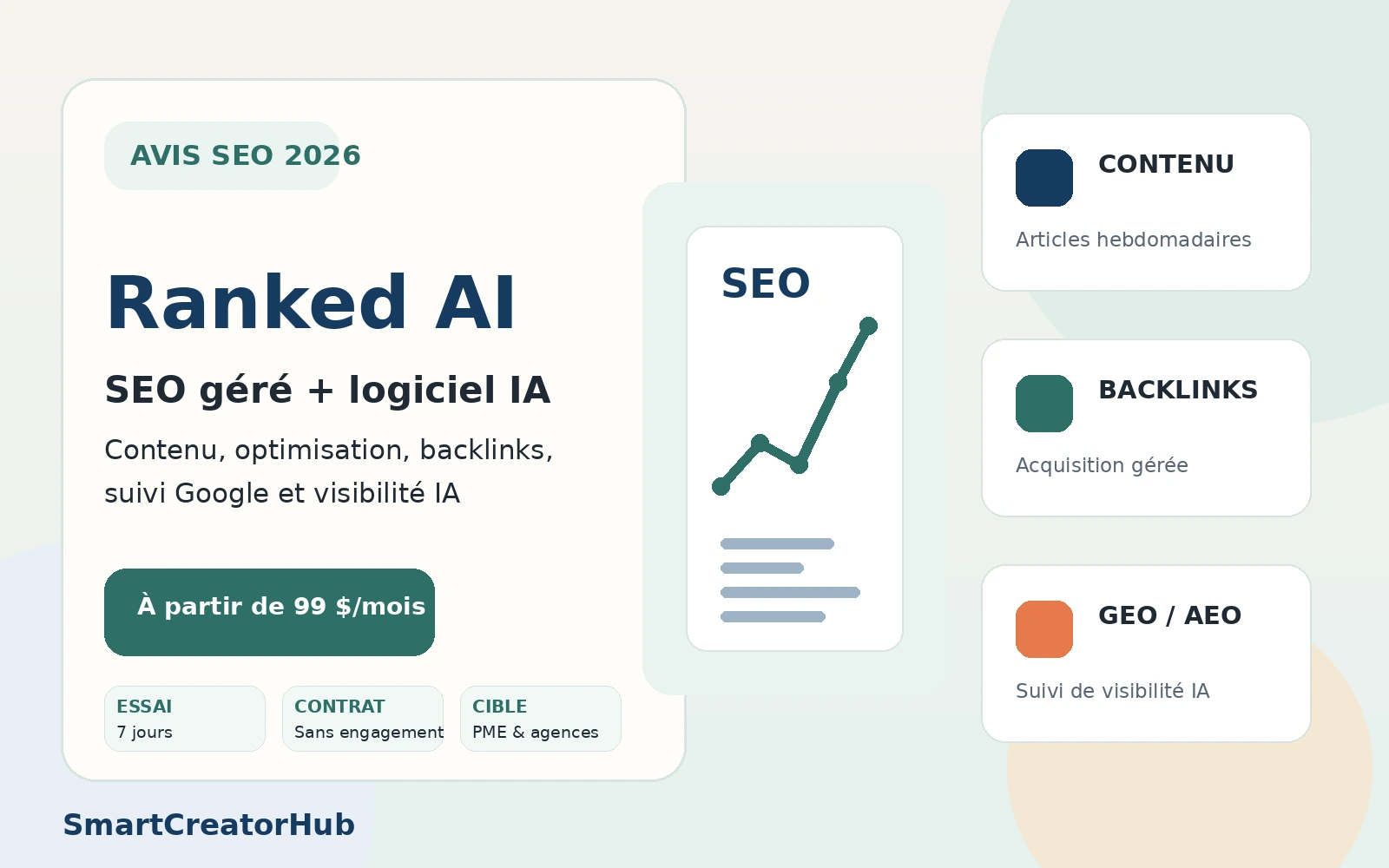
Ranked AI is relevant when you want a managed or guided SEO workflow that also pays attention to visibility in AI answer engines. It should not be treated as a guarantee that ChatGPT, Gemini or Perplexity will cite your site. The useful question is whether the service gives you better execution, measurement and prioritization than you would get from a conventional SEO workflow.
- Useful when you want execution plus AI-visibility awareness.
- Do not interpret any GEO metric as a citation guarantee.
- Compare deliverables, measurement and editorial quality — not the label “AI SEO.”
What problem Ranked AI tries to solve
Classic SEO tools were built around search-engine rankings, keywords and backlinks. AI answer engines introduce additional questions: is the brand mentioned, is the site cited, what sources appear around the same prompts and how does visibility change across engines?
Ranked AI is relevant when a team wants those newer signals connected to a broader search workflow rather than managed in spreadsheets and manual prompt runs.
SEO and GEO are related, but not identical
A page that ranks well in Google can become a source for AI systems, but AI visibility is not simply a second rank-tracking column. Different systems retrieve, synthesize and cite information differently. Some answers contain citations; some do not. Results can vary by prompt wording, location, user context and time.
A useful GEO workflow therefore needs repeated prompt sets, engine-specific reporting and evidence of which sources were cited. One snapshot is not enough.
What to evaluate in an AI visibility platform
- Which AI engines are tracked and how often?
- Can you preserve prompt sets and compare results over time?
- Does the product show actual citation/source evidence, not only a proprietary score?
- Can you separate branded prompts from non-branded discovery prompts?
- Can you export or audit the data when a KPI changes?
Where Ranked AI can be useful
For a small marketing team, the main benefit is process. Instead of running ad-hoc checks, you can define a stable set of questions and compare visibility over time. That makes it easier to connect content changes with observable outcomes.
It can also be useful when AI visibility is one part of a broader SEO program. Traditional search remains a major discovery channel, so a platform that keeps both layers in view can reduce tool fragmentation.
What Ranked AI cannot guarantee
No GEO product controls how ChatGPT, Gemini, Claude or Perplexity generate answers. A vendor can help you identify gaps, improve content structure, strengthen source quality and monitor results, but it cannot guarantee a citation or recommendation on demand.
Treat any “AI visibility score” as a measurement model. The underlying evidence — prompts, mentions, citations and source pages — is more important than the number by itself.
How we would test it before committing
Build a small benchmark manually first: 20 to 40 prompts split between branded and non-branded questions. Record which engines mention the brand, which pages are cited and which competitors appear. Then compare the platform’s reporting with your benchmark.
If the product saves time, expands coverage and preserves evidence without obscuring the raw results, it is doing useful work.
What would make an AI visibility tool worth the subscription?
The subscription earns its place when it replaces recurring manual work and improves decisions. A useful platform should let you maintain a stable prompt set, compare engines, preserve source evidence, identify which competing domains are cited and show changes over time without forcing you to rebuild the analysis in a spreadsheet every week.
The platform is less valuable if the team only checks a handful of prompts occasionally. In that case, a disciplined manual benchmark can be more transparent and effectively free. The break-even point depends on how many markets, products and engines you need to monitor and how much analyst time the software replaces.
Before renewing, review decisions made because of the tool. If the dashboard generates scores but no content priorities, source opportunities or measurable experiments, the reporting layer may be interesting without being operationally useful.
For agencies, reporting flexibility can be decisive. A client rarely needs another abstract score; they need evidence of what changed, which prompts moved, what sources were cited and what action is recommended next. If the platform can export that evidence cleanly and separate projects, markets or brands, it becomes easier to turn monitoring into a repeatable service rather than an internal curiosity.
Frequently asked questions
Can Ranked AI guarantee ChatGPT citations?
No. No third-party platform controls the output of AI answer engines.
Is GEO the same as SEO?
No. They overlap, but AI visibility adds prompt-based mentions, citations and source-selection behavior that cannot be reduced to a conventional keyword rank.
Who should use an AI visibility platform?
Teams that need recurring measurement across a stable prompt set and multiple AI engines are the clearest fit.
Sources and verification
Product capabilities and pricing can change. We prioritize first-party documentation for purchase-critical details and recommend checking the vendor before subscribing.