Updated October 9, 2026 · Pricing, features and migration
Beehiiv vs Substack in 2026: Pricing, Features & When to Switch
Beehiiv and Substack can both publish a newsletter and charge readers. The choice depends on how you will find those readers, which publishing tools you need, and what each platform costs at your actual audience size. This comparison covers the features first, then the numbers and the trade-offs of switching.
Beehiiv or Substack: which should you choose?
Choose Substack if you want to publish without a recurring platform bill and actively use its reader app, Notes and recommendations. Choose Beehiiv if you have a distribution strategy and need its advertising, automation or publication controls. For paid newsletters, compare the Beehiiv plan quote with Substack's 10% platform fee at your expected revenue.
Our recommendation: do not migrate solely because one fee looks smaller. Measure how new paying readers find you, then compare the savings with the audience and workflow you would need to rebuild.
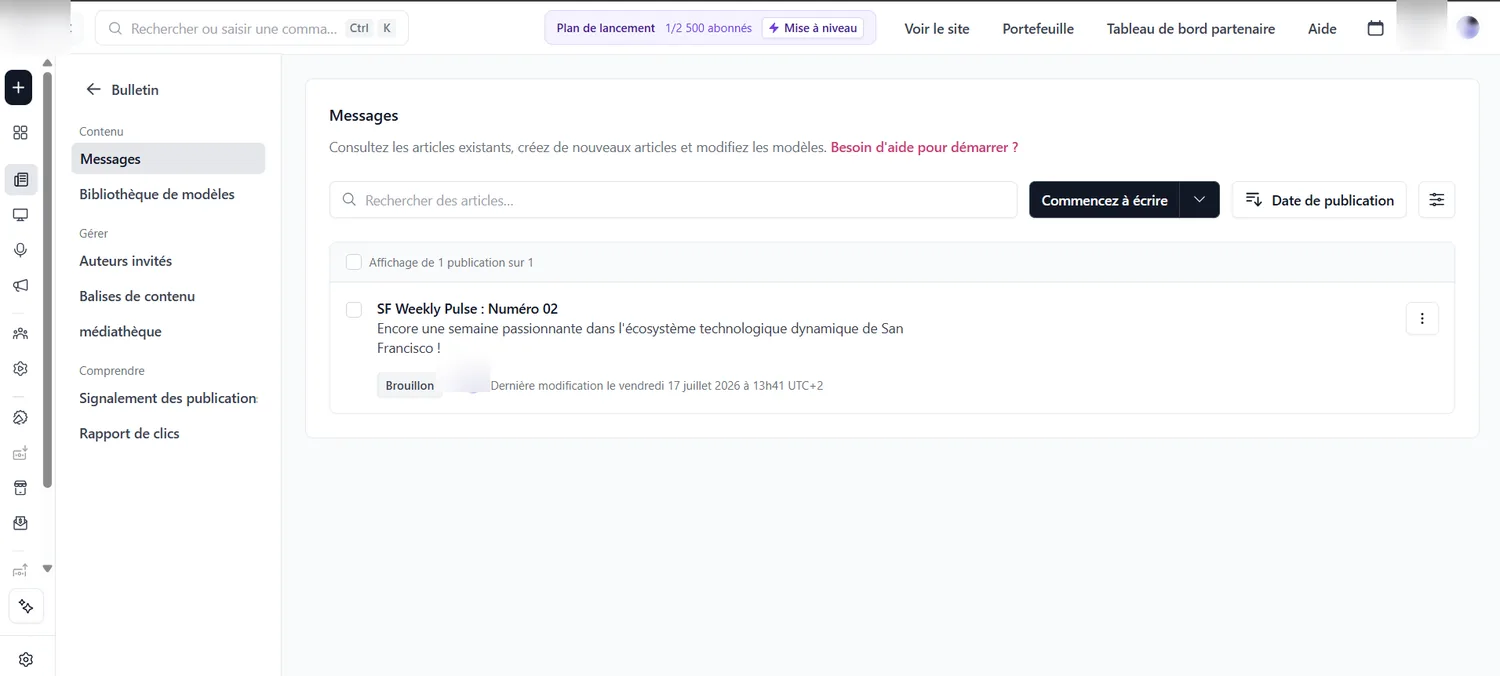
Basis of this comparison: official product and support documentation checked October 9, 2026. The cost examples are our calculations, not vendor earnings forecasts. Our retained Beehiiv screenshot documents a September account inspection; we have not run a controlled audience-growth test between the platforms.
Beehiiv vs Substack: features at a glance
Use this table to shortlist the platform, then check the cost and migration conditions below. A feature matters only if it solves a task your publication actually has.
| What matters | Beehiiv | Substack |
|---|---|---|
| Free publishing | Free up to 2,500 subscribers; paid subscriptions require Lite or above. | No recurring publishing fee at any list size; 10% platform fee when readers pay. |
| Paid-newsletter cost | Subscriber-based plan bill plus payment processing; 0% platform take rate. | 10% of paid-subscription payments plus separate payment charges. |
| Reader acquisition | Recommendations, reader incentives and paid acquisition tools. | App, Notes, recommendations and subscriber referrals. |
| Email workflows | Visual workflows and segmentation; Lite supports 10 live automations. | Lifecycle drip campaigns are documented; assess your required triggers. |
| Website and branding | Website builder; new custom domains require a paid plan, branding removal requires Pro or Enterprise. | Hosted publication with layout options; optional custom domain costs $50 once. |
| Advertising | Ad Network offers on paid plans; access does not guarantee income. | Native sponsorship formats and eligible Creator Kits; matching is not guaranteed. |
| Community and media | Website Community and podcast tools; inspect the experience readers will use. | Reader app, Notes, Chat, podcasts, video and live publishing. |
| Moving away | Subscriber and content exports; rebuild platform-specific workflows. | Exportable audience; Stripe billing, Apple billing and content need different treatment. |
Official sources: Beehiiv plan matrix · Substack feature documentation · Substack costs.
Which platform fits your newsletter business?
Starting a writing habit
Shortlist Substack for its reader environment, or Beehiiv Free if you want its publication workflow. Publish consistently before buying tools you may not use.
Charging readers
Run the fee comparison at your total audience size. Beehiiv can cost less at sufficient paid revenue; Substack discovery may still justify its commission.
Building a sponsored publication
Assess Beehiiv's advertising tools against your audience and offers. Compare Substack sponsorship eligibility separately from free publishing.
Our verdict: favor Substack when the reader network and publishing experience are central to your product. Favor Beehiiv when a defined distribution strategy and publication workflows justify its bill. A creator with a large free list and few paying readers should be especially careful with fixed costs.
Beehiiv vs Substack pricing: which costs less?
Compare Beehiiv's actual plan bill with Substack's 10% of paid-subscription revenue. Beehiiv prices by active subscribers; Substack's platform commission depends on reader payments. The right answer needs both your total audience and your paying-reader count.
For monthly reader subscriptions, let P be the Beehiiv monthly plan cost and R your monthly gross paid-subscription revenue. Platform fees are equal when R = 10 × P. Beehiiv costs less on this one expense above that revenue, not at equality.
Official sources: Beehiiv subscriber selector and billing options · How Beehiiv counts active subscribers · Substack platform and payment fees.
Total audience changes the answer: four worked examples
A 3,000-reader audience falls in Beehiiv's up-to-5,000 tier. The scenarios below use Lite paid monthly, with every paying reader charged $10 per month.
| Audience / paid readers | Substack commission | Beehiiv Lite bill | Lower platform cost |
|---|---|---|---|
| 3,000 total / 100 paid | $100 on $1,000 revenue | $109 | Substack by $9/month |
| 3,000 total / 200 paid | $200 on $2,000 revenue | $109 | Beehiiv by $91/month |
| 10,000 total / 100 paid | $100 on $1,000 revenue | $139 | Substack by $39/month |
| 10,000 total / 500 paid | $500 on $5,000 revenue | $139 | Beehiiv by $361/month |
These are calculations, not observed earnings. Processing, taxes, refunds, acquisition spending and transition costs are excluded. The plan must support the workflows you need; Lite is not automatically sufficient for every publication.
How many paid subscribers make Beehiiv cheaper?
For readers paying $10 monthly and Lite paid monthly, the first strictly cheaper paid-reader count is shown below. At a different reader price q, equality is P ÷ (0.10 × q); take the next whole reader count to be strictly below Substack's platform commission.
| Total active audience | Revenue at equal fees | First cheaper paid-reader count |
|---|---|---|
| 1,000 | $590/month | 60 paid readers; equality at 59 |
| 3,000 | $1,090/month | 110 paid readers; equality at 109 |
| 10,000 | $1,390/month | 140 paid readers; equality at 139 |
| 25,000 | $1,990/month | 200 paid readers; equality at 199 |
A large free list with few paying readers can therefore favor Substack even when Beehiiv takes 0%. For the detailed Beehiiv plan choice and product limitations, use our Beehiiv review; this comparison evaluates the difference between platforms.
What about Stripe and other payment fees?
Payment costs are separate from the platform comparison. Substack lists card processing and recurring-billing charges, with a US-card example; Beehiiv also documents payment-processing fees. Country, payment method, currency and transaction frequency affect the full cost. Do not treat the fee savings above as net profit, or assume every processing charge cancels between platforms.
Annual subscriptions: separate the reader's payment from your plan
Paying Beehiiv annually and charging readers annually are two different decisions. Annual Lite at 1,000 active subscribers costs $588 upfront, equivalent to $49/month. Against a steady monthly-reader revenue stream, equal platform fees are $490/month; the monthly Lite contract instead reaches equality at $590/month.
For an annual-reader example, take 10,000 active subscribers, including 100 paying $80 per year. Their gross annual payments are $8,000. Substack's platform commission is $800; Lite paid annually costs $1,428. Substack is $628 cheaper on those platform costs. At the same reader price and audience tier, 179 paying readers make annual Lite strictly cheaper.
The annual example assumes all readers pay the stated amount over a full year, with a constant plan tier and no refunds or discounts. Compare payments for the same period; a dashboard's annualized revenue is not necessarily cash collected in that year.
Is switching from Substack to Beehiiv worth it in 2026?
Switching is worth considering when the fee savings or workflow benefits outweigh the migration effort and the value of Substack discovery to your publication. A large subscriber count alone does not establish that.
Use three numbers: your actual Beehiiv quote, your paid revenue, and the contribution from readers acquired inside Substack. Also list the specific workflow you would improve. “More features” is too vague; “a welcome sequence that replaces a weekly manual task” is a benefit you can evaluate.
Stay on Substack
You have little paid revenue, enjoy the publishing workflow, and its network is a meaningful source of engaged readers.
Evaluate Beehiiv
Your audience comes mainly from external channels, your platform-fee savings are material, or a specific paid capability solves an operating problem.
Test before moving
You depend on Substack conversations or recommendations, have complex paid tiers, or cannot yet explain how the new workflow will repay its cost.
How much revenue loss would erase the fee savings?
Start with a scenario, not a predicted migration loss. If staying on Substack would produce $3,000/month in gross paid revenue and the Beehiiv bill is $109/month, the platform-fee saving is $300 − $109 = $191/month. A hypothetical $150/month reduction in gross revenue leaves $41 of that advantage before other costs.
With an additional one-time transition cost of $400, a constant $41 monthly advantage takes about 9.8 months to repay it. This illustration excludes payment fees and taxes. It does not predict churn, prove a platform caused revenue, or imply imported subscribers will stop paying.
The general scenario is 0.10 × R − P − D, where R is gross revenue if you stay, P is the Beehiiv bill, and D is hypothetical gross revenue foregone after the move. If the result is negative, the fee saving alone does not justify switching under those assumptions.
Is Beehiiv still worth it after the October price change?
Beehiiv renamed Launch to Free, Scale to Lite and Max to Pro. New-customer pricing began October 1; existing customers move at their first renewal on or after November 1, with current annual pricing retained until renewal. An older comparison can therefore use a price that does not match a new signup today.
Official source: October plan changes and renewal dates.
Our judgment: a higher fixed fee makes low-revenue publications more sensitive to the choice. It does not remove Beehiiv's potential value for a publication earning enough subscription revenue or using paid tools effectively. Review the renewal quote, not a historical screenshot.
Beehiiv or Substack for a beginner with no audience?
Substack is a reasonable starting point when you want to write and participate in an existing reader network. Beehiiv Free is a reasonable starting point when you want to build a publication and already have a plan for distribution. Neither platform supplies a guaranteed audience.
Substack's app, Notes and recommendations provide places to participate and be discovered. That advantage matters only if your intended readers use them and you will invest in the network. Beehiiv Free supports up to 2,500 subscribers and unlimited sends, so you can validate a publishing habit without immediately purchasing a growth stack.
Official sources: Substack's reader-network features and Beehiiv Free limits. Each vendor's comparison expresses its own positioning; use support documentation for precise entitlements.
Before paying for either workflow, publish several useful issues and identify a repeatable way to reach interested readers. The right early metric is whether people read, reply and return—not the number of unused features in the dashboard.
Which grows a newsletter faster: Beehiiv or Substack?
There is no universal growth winner. Substack offers network discovery; Beehiiv offers publication growth tools. Your topic, distribution effort and reader retention determine whether those mechanisms work for you.
Both have recommendations. Beehiiv's recommendation system supports cross-promotion between publications; it should not be described as having no discovery mechanisms. Substack also has subscriber referrals with configurable rewards, so reader incentives are not exclusive to Beehiiv.
Official sources: Beehiiv recommendations and Substack subscriber referrals and rewards.
Our evaluation method: separate readers acquired through platform recommendations from readers acquired through your website, social accounts, partnerships or advertising. Then compare activation, paid conversion and retention by source. A channel that attracts many signups but few engaged readers may contribute less than a smaller channel.
When evaluating a move, estimate the contribution you could lose—not just the number of subscribers you can export. Bringing an email list to a new service does not bring the old platform's discovery environment with it.
Which analytics should inform the choice?
Substack's Sources reports show visitors, new subscribers and new revenue by source. Its Network categories include app signups, recommendations, saved cards and existing accounts. These are not all equivalent to readers who discovered you inside Substack.
Official sources: Substack acquisition and retention metrics.
Use your own acquisition and retention reports to assess where readers come from. For Beehiiv, check whether the reporting and segmentation in your intended plan answer the same business questions. A source label is useful evidence, but it does not prove what revenue you would have earned on another platform.
Beehiiv vs Substack for a free newsletter funded by ads
A free-to-read newsletter needs a different calculation from a paid newsletter. Substack's 10% paid-subscription fee is not 10% of a sponsorship invoice; Beehiiv's fixed plan cost still matters even if readers pay nothing.
Beehiiv's Ad Network is available on paid plans. Publishers can browse offers and place ads, with CPC or CPM economics. Its estimated earnings are projections, and offer availability is limited. Buying access is not equivalent to securing profitable advertising revenue.
Official source: Beehiiv Ad Network access, offers and earnings definitions.
Our decision rule: compare realistic advertising contribution after the plan bill and selling effort. If you already negotiate sponsors directly, assess what the platform saves in administration. If you have no advertising history, use a conservative scenario rather than assuming a marketplace will cover the subscription.
A hypothetical $100/month plan and $150 of monthly advertising contribution leave $50 before your other costs. Those figures illustrate the calculation; they are not Beehiiv prices or an income forecast. A free readership can support a business, but its size alone does not establish its commercial value.
Substack sponsorships are no longer just manual deals
Substack's October 8 announcement describes sponsored upgrades, unlocked posts and masthead partnerships. Creator Kits express interest in matching; the help page lists Bestsellers or publications with at least 100 paid subscribers as eligible. This is not guaranteed inventory for every free newsletter.
Official sources: Substack sponsorship formats announced October 8 · Creator Kit eligibility and matching.
Our choice rule: Beehiiv is worth evaluating for a publication that wants advertising offers integrated into its email workflow. Substack deserves consideration when paid writing and sponsor-funded access fit the publication. Direct sponsor sales are a third route; assess selling effort and actual contribution in each case.
Automation and segmentation: which workflow do you need?
Beehiiv Lite supports up to ten live automations across a workspace; Pro and Enterprise offer unlimited live automations, with advanced click triggers and automation A/B testing. A planned welcome or re-engagement sequence gives you a concrete reason to assess these limits.
Official source: Beehiiv automation triggers, actions and plan limits.
Substack's official features page describes lifecycle drip campaigns for new free or paid subscribers, founding members and churned readers. Do not choose Beehiiv on the assumption that Substack has no sequences. A welcome series and a workflow that updates custom fields, branches or connects external systems need different checks.
Official sources: Substack lifecycle email sequences.
For a marketing-led publication, compare the exact segmentation conditions, triggers and actions you will use. For a writing-led publication, a simpler subscriber lifecycle may be sufficient. We have not run a controlled automation test on both accounts.
Community, podcasts and video: where will readers participate?
Beehiiv Community now supports channels, discussion, reactions and direct or group messages on a publication website. Substack combines community with its reader app and Notes. Compare where your readers want to participate rather than claiming Beehiiv has no community or that the two environments are identical.
Official sources: Beehiiv Community capabilities and Substack app, Notes and community.
Substack includes native podcast, video and live publishing alongside its reader network. Beehiiv offers podcast tools and website community features. If audio or video is central to your product, inspect hosting, distribution and paid access before choosing; a supported medium is not a promise that every old post will import.
Websites, customization and SEO: what changes the decision?
Beehiiv's website builder is useful when your newsletter needs a branded publication site. Substack offers publication layouts inside its reader ecosystem. Compare the pages you need, layout options, branding rules and the editing experience; avoid paying for design controls you will not maintain.
Is either platform automatically better for SEO?
No ranking advantage follows automatically from the platform name. Inspect your public archive, editable metadata, indexability and domain setup. If you migrate, check important URLs and links individually; an imported post is not proof that its old traffic will follow.
Substack lists an optional $50 one-time custom-domain fee. Beehiiv's downgrade documentation distinguishes existing custom domains, which can remain on Free, from adding a new custom domain, which requires a paid plan. Budget for your actual setup rather than assuming a fresh free account includes every domain capability. For a full archive and AI-discovery method, use our newsletter visibility guide.
Official sources: Substack domain fee and Beehiiv plan changes and custom-domain rules.
Can you migrate from Substack to Beehiiv without starting over?
You can move an email audience, but access, billing and content are separate migrations. Review the following cases before deciding that the switch is simple.
| What you have | What to check |
|---|---|
| Free readers | Import contacts and review fields and subscriber status. |
| Stripe-paid subscriptions | Set up paid tiers and verify price mapping and billing before ending the old setup. |
| Apple-billed subscriptions | Apple billing does not move through Stripe; plan separate access and reader communication. |
| Gifted or complimentary access | Confirm access periods separately from recurring payments. |
| Archives and conversations | Comments, categories, galleries and video/podcast-type posts are outside the standard importer; review paywalls and code formatting. |
Official sources: Migration rules, paid access and content limitations.
Protect the reader experience and important URLs
Check billing, sender identity and representative archive pages before announcing completion. A custom-domain move and a move from a platform subdomain have different URL constraints. Map valuable URLs, check redirects where available, and inspect images and internal links. Importing posts does not demonstrate preserved rankings.
Official sources: Google guidance for site moves and URL mapping.
Our recommendation is to verify a small representative set: a free post, a paywalled post, a reader from each billing type and the archive pages with meaningful search traffic. The decision here is whether the transition is worth undertaking; use the official guide for the current steps.
A decision checklist before choosing or switching
- Identify your revenue model. Reader subscriptions, advertising and product sales produce different cost comparisons.
- Get the correct Beehiiv quote. Use your full audience and intended billing interval.
- Measure your distribution. Determine which channels supply engaged and paying readers.
- Name the operating benefit. Choose one workflow to test rather than paying for an abstract feature advantage.
- Price the transition. Include your time, content repairs and disruption to reader habits.
- Decide what would justify staying. A working publication should not move merely because another platform has persuasive marketing.
Compare the actual quote with your publication's numbers
Use the official pricing selector, then check the migration guide against your subscriber and content types.
Beehiiv vs Substack: frequently asked questions
Is Beehiiv better than Substack?
Beehiiv can suit a publication with a defined distribution strategy and workflows that justify its plan cost. Substack can suit writers who value its reader network and publishing environment. Compare your revenue model, audience source and required features rather than choosing a universal winner.
How many paid subscribers make Beehiiv cheaper than Substack?
For platform fees alone, at 1,000 active subscribers and Lite paid monthly at $59, readers paying $10/month reach equality at 59 paid readers and make Beehiiv cheaper at 60. At 3,000 active subscribers, Lite costs $109/month and the first cheaper count is 110. Processing and other costs are excluded.
Which is cheaper for a large free newsletter?
Substack has no recurring publishing fee at any list size. Beehiiv Free supports up to 2,500 subscribers; beyond that, compare the paid bill with the value of your required tools. Having a large list does not by itself establish enough revenue to cover the bill.
Does Beehiiv charge 10% like Substack?
No. Beehiiv advertises a 0% platform take rate on paid subscriptions; payment processing and the paid plan still cost money. Substack charges a 10% platform fee on paid subscriptions, plus separate payment charges.
Does annual billing change the comparison?
Yes. Distinguish your annual Beehiiv contract from your readers' annual subscriptions. Compare the software bill and Substack commission over the same period, using actual reader payments and the applicable audience tier.
Which should a beginner with no audience choose?
Consider Substack if you want to publish and participate in its reader network. Consider Beehiiv Free if you want to build a publication with a distribution plan. Neither guarantees readers.
Does Substack support email automations?
Substack's official features page lists lifecycle drip campaigns. Compare the triggers and segmentation your workflow needs with Beehiiv's visual automations; the two feature sets should not be assumed identical.
Does Substack have a reader referral program?
Yes. Substack supports subscriber referrals with reward tiers for free and paid publications. Referrals are not exclusive to Beehiiv.
Can I transfer Substack's iOS subscribers through Stripe?
No. Apple-billed subscriptions need separate handling. Moving content access is not the same as transferring recurring billing.
Will my Substack comments move to Beehiiv?
No. Comments are outside the documented importer. Review community continuity separately from the contact-list transfer.
Is switching platforms a reliable way to grow faster?
No. A switch changes tools and distribution conditions. Evaluate how you will acquire and retain readers; moving the list does not transfer a platform's discovery network.
Official sources and verification
Checked October 9, 2026. Sources are attached to the relevant sections; this index lets you verify the underlying rules directly.
- Beehiiv pricing and billing options
- Beehiiv October plan announcement
- Substack platform and payment fees
- Substack's product positioning and network features
- Beehiiv recommendations
- Substack subscriber referrals
- Beehiiv Ad Network
- Beehiiv automation limits
- Beehiiv Community
- Beehiiv plan changes and domains
- Beehiiv migration guide and limitations
- Beehiiv active-subscriber billing tiers
- Substack feature documentation and sequences
- Substack acquisition metrics
- Substack October sponsorship announcement
- Substack Creator Kit eligibility
- Google site-move guidance