Newsletter platform review · Updated September 2026
Beehiiv Review 2026: Pricing, Features, Pros & Cons
Beehiiv has grown from a newsletter tool into a broader publishing platform with a website, audience growth, paid subscriptions, advertising, digital products, Community, analytics, automations and AI integrations. This review focuses on the question that matters before paying: what does Beehiiv actually give you in 2026, where does it fall short, and who is it best for?
The short answer
Is Beehiiv worth it?
Beehiiv is a strong fit for newsletter-first creators, publishers and media businesses that want growth and monetization tools built into the same platform as publishing. The Launch plan is unusually capable for a free tier, while Scale becomes the meaningful upgrade when you need automations, monetization and deeper operational tools.
The trade-off is that the paid price increases with your active subscriber count, and Beehiiv is not the deepest option for complex CRM or ecommerce lifecycle automation. Its strongest case is an audience business built around recurring content.
How we reviewed it: SmartCreatorHub checked Beehiiv's current pricing and documentation, and we also used a real Launch account to inspect the dashboard, editor, website tools, automations and custom-domain flow. Personal publication data in the screenshots is anonymized. We do not claim to have tested paid features that were inaccessible from Launch.
Beehiiv at a glance
| Category | Current position | Why it matters |
|---|---|---|
| Free plan | Launch, up to 2,500 active subscribers | Enough to validate a newsletter before paying. |
| Paid plans | Scale, Max, Enterprise | Advanced growth, revenue and operational features are plan-gated. |
| Sending | Unlimited email sends | No send-volume ladder on the core plans. |
| Website | Included | Newsletter issues can live on a public publication site. |
| Custom domain | Available on Launch | You can build on your own brand before upgrading. |
| Automations | Paid | Important boundary between basic publishing and lifecycle workflows. |
| Monetization | Paid subscriptions, Ad Network, Paid Recommendations, products and more | Beehiiv is designed around turning an audience into a business. |
| AI | Agent + MCP + AI creation tools | 2026 Beehiiv is significantly more AI-connected than older reviews suggest. |
What is Beehiiv?
Beehiiv is a newsletter publishing and audience platform. The easiest way to understand it is not as an email campaign tool with a blog attached, but as an operating system for a publication: you create content, distribute it by email and web, grow the audience, analyze behavior and add revenue streams from the same account.
That orientation shapes the entire product. A traditional email-marketing suite often starts with contacts, funnels and campaigns. Beehiiv starts with the publication itself. That makes it particularly relevant to newsletter creators, media brands, independent publishers and businesses where recurring editorial content is a strategic acquisition channel.
Publish
Newsletter editor, web publication, custom domains, posts, pages and podcast support.
Grow
Recommendations, referral programs, forms, surveys, segmentation and acquisition analytics.
Monetize
Subscriptions, ads, Paid Recommendations, digital products, sponsorships and Community.
What changed in Beehiiv in 2026?
Freshness matters with Beehiiv because several older reviews now describe a product that no longer exists in exactly the same form. The biggest 2026 changes are not cosmetic: they affect growth, AI workflows and the overall scope of the platform.
- Boosts became Paid Recommendations: Beehiiv reorganized the recommendation system so free and paid recommendations sit under a unified Recommendations model. Older articles that repeatedly refer to Boosts are using the previous terminology.
- Community: Beehiiv added a native community layer on paid plans, allowing a publication to extend beyond inbox and website into member discussions.
- Beehiiv Agent: an integrated AI assistant can work with publication context inside Beehiiv.
- MCP access: Beehiiv documents Model Context Protocol access for compatible external AI tools, with permissions depending on the plan.
- AI crawler controls: higher plans include more control over AI bot access to publication content.
Beehiiv pricing in 2026: what you actually pay
Beehiiv currently has four plan levels: Launch, Scale, Max and Enterprise. Launch is free. Scale and Max use subscriber-tier pricing, so the headline entry price is only the starting point; your cost changes as the number of active subscribers grows.
| Plan | Starting price | Best for | Important unlocks |
|---|---|---|---|
| Launch | $0 | Starting and validating a newsletter | 2,500 subscribers, unlimited sends, website, custom domain, core analytics, Recommendations |
| Scale | $49/month at the entry monthly tier | Growing and monetizing publications | Automations, paid subscriptions, Ad Network, digital products, Community and more |
| Max | $109/month at the entry monthly tier | Professional publishers needing more control | Remove Beehiiv branding, sponsorship tools, additional AI/bot controls and premium capabilities |
| Enterprise | Custom | Larger media and publishing organizations | Custom scale, support and enterprise requirements |
Monthly versus annual billing
At the entry tier, Beehiiv currently presents Scale at $49 month-to-month and an annual equivalent around $43 per month when $517 is billed for the year. Max is $109 month-to-month and around $96 per month equivalent when $1,151 is billed annually. The annual number should be read as an effective monthly rate, not a monthly payment schedule.
Pricing increases with active subscribers
The important phrase is active subscribers. Beehiiv's plan tier is based on subscribers you actively send to rather than every address that has ever existed in the account. That means the correct budgeting question is not simply “What does Scale cost?” but “What does Scale cost at the audience size I expect to maintain?”
Costs people often miss
- Audience growth: a larger active list can move you into a higher paid tier.
- Payment processing: Beehiiv advertises a 0% platform take rate on paid subscriptions, but payment processor fees can still apply.
- Feature gating: removing Beehiiv branding and some publisher controls require Max rather than Scale.
- Annual billing: the lower advertised monthly equivalent requires paying the year in advance.
Check the current official Beehiiv price for your subscriber tier before budgeting, because the relevant paid price depends on list size.
Is Beehiiv free?
Yes. Beehiiv's Launch plan is permanently free for up to 2,500 active subscribers and includes unlimited email sends. This is one of the platform's strongest acquisition advantages because you can build a real publication on your own domain before deciding whether the paid growth and revenue tools are worth the upgrade.
What you can do on Launch
- publish newsletters and web posts;
- send unlimited emails within the subscriber limit;
- use a hosted publication website;
- connect a custom domain;
- review campaign analytics;
- use the Recommendation Network;
- access core API/MCP/Agent capabilities within the permissions of the free tier.
What pushes you toward Scale
The free plan becomes restrictive when Beehiiv stops being only a publishing tool and starts becoming your growth and revenue infrastructure. Automations, paid monetization features, Community and several advanced operating tools are the main reasons to move to Scale.
Start with the free plan if you are still validating the publication
Launch is large enough to test the editor, website, domain setup and core publishing workflow before paying for Scale.
Create a free Beehiiv accountWhat we saw in a real Beehiiv Launch account
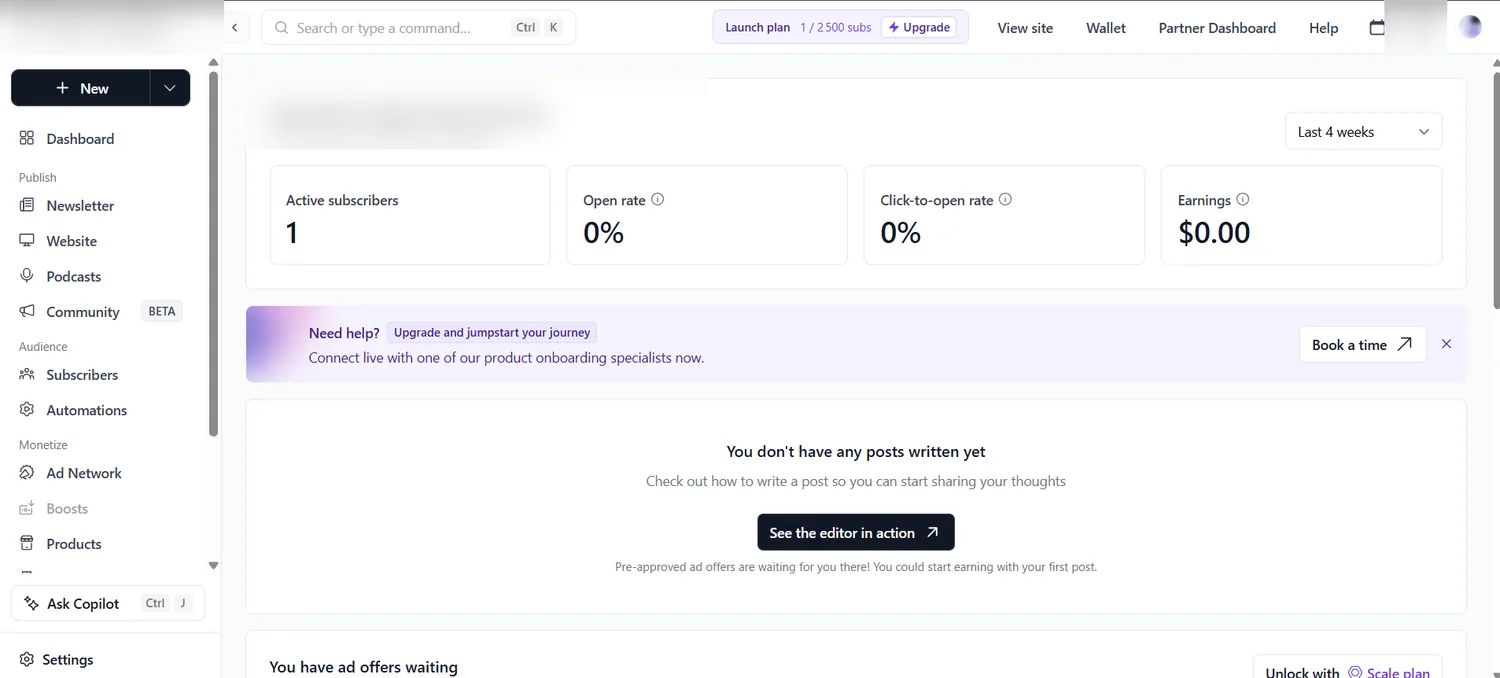
Documentation tells you what Beehiiv promises. A real account is useful for seeing what is actually exposed to a user before upgrading. We used a Launch account and checked the dashboard, editor, automation builder, website area, public signup page and custom-domain flow.
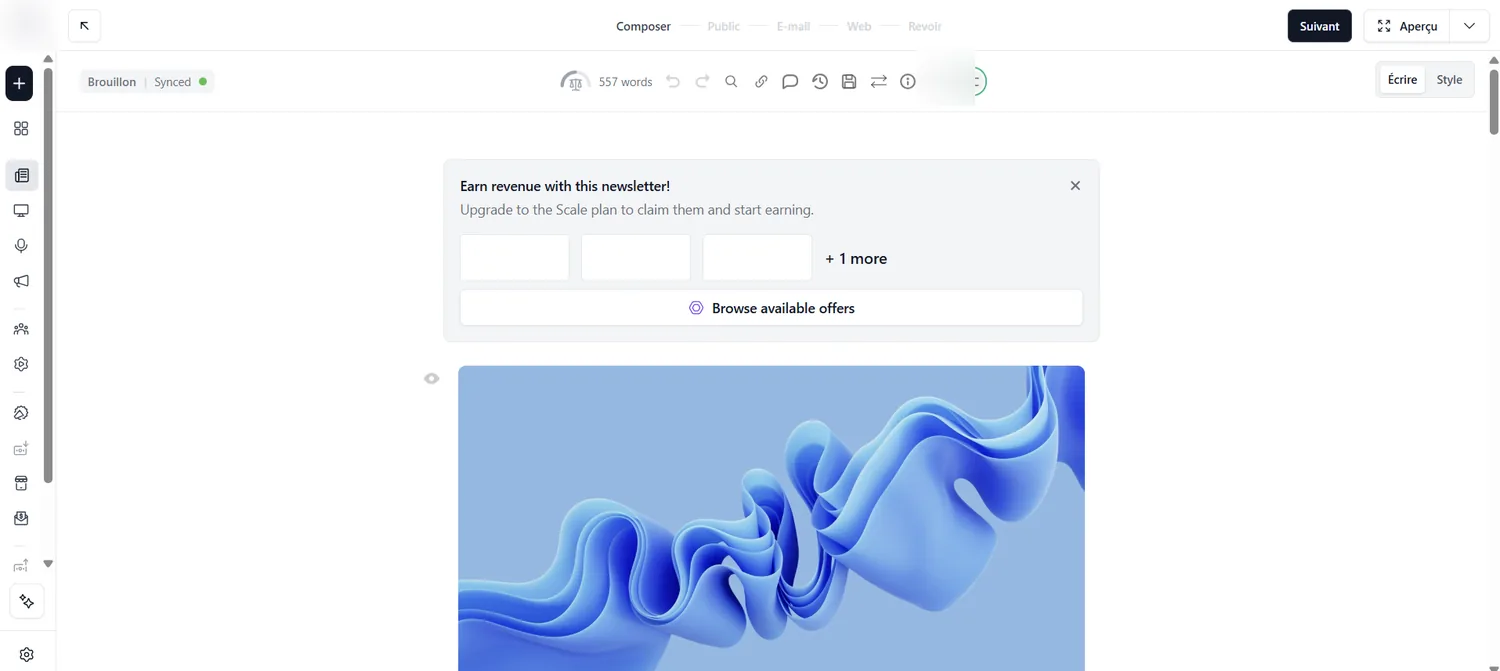
The editor keeps email and web publishing close together
In our account, the writing interface made the email and web publication steps part of the same workflow. That is useful if you want each newsletter issue to become both an inbox message and an indexable public post rather than maintaining two separate publishing systems.
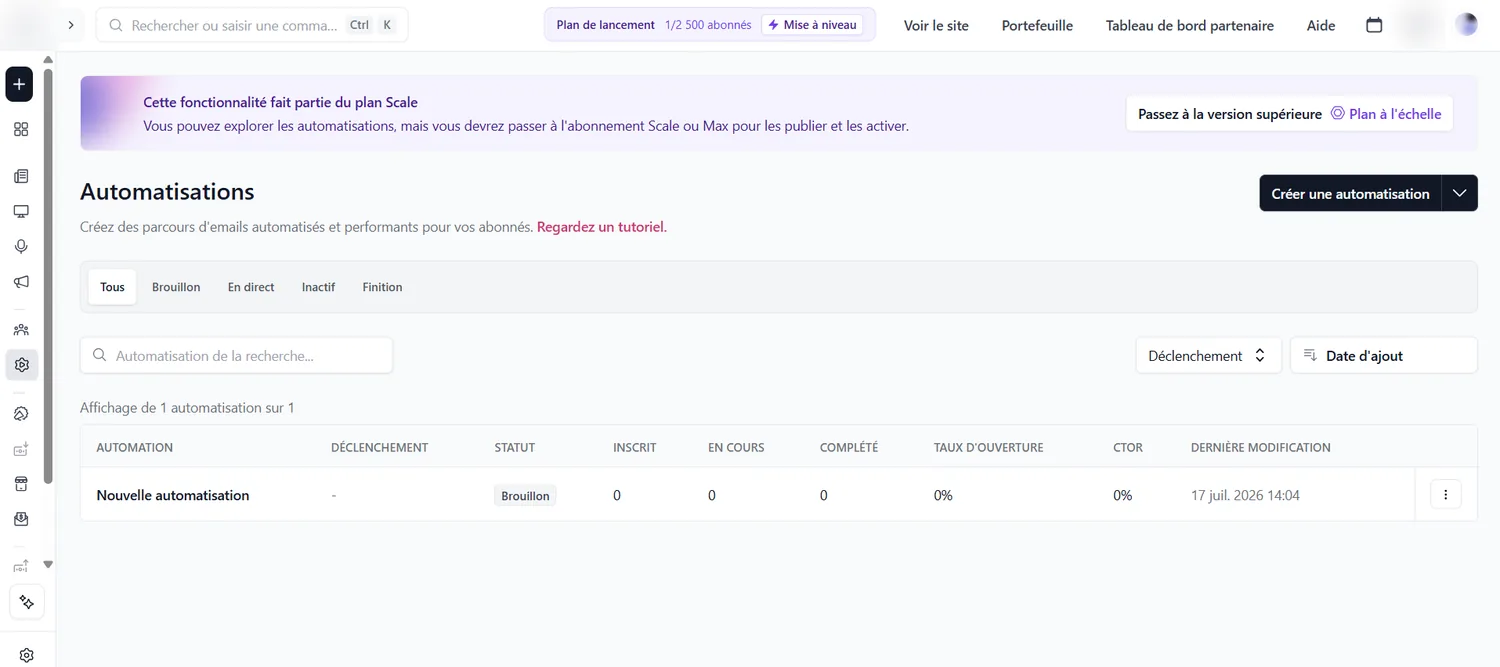
You can inspect automations on Launch, but activation is paid
The automation builder was visible in our Launch account, including several trigger types, but Beehiiv explicitly required Scale or Max to publish and activate the automation. That is a good example of how the free plan lets you understand the product while reserving operational leverage for paid tiers.
The website is usable immediately
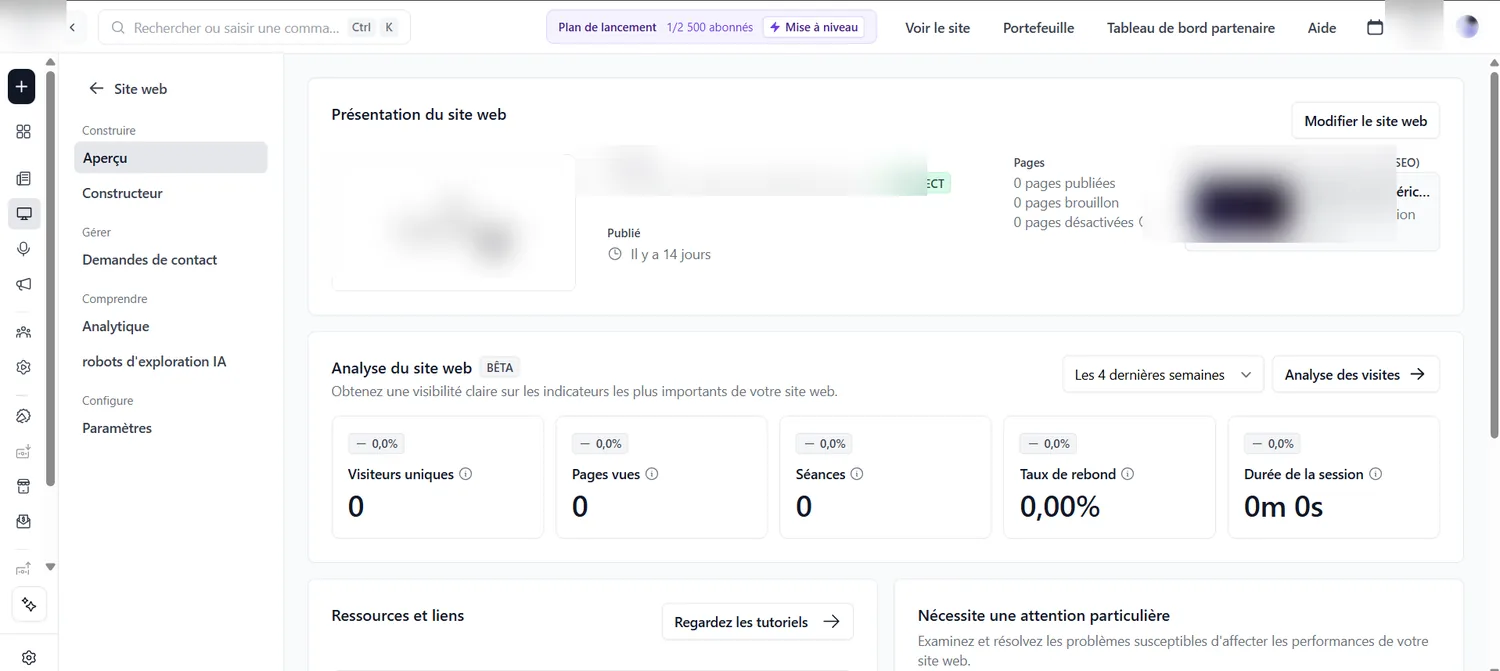
Beehiiv generated a public site and signup experience from the start. The web area exposed an SEO preview, builder access and website analytics. This is practical for launching quickly; a publication with a highly distinctive visual identity will still need more design work than the default presentation.

Custom-domain setup separates web and sending concerns
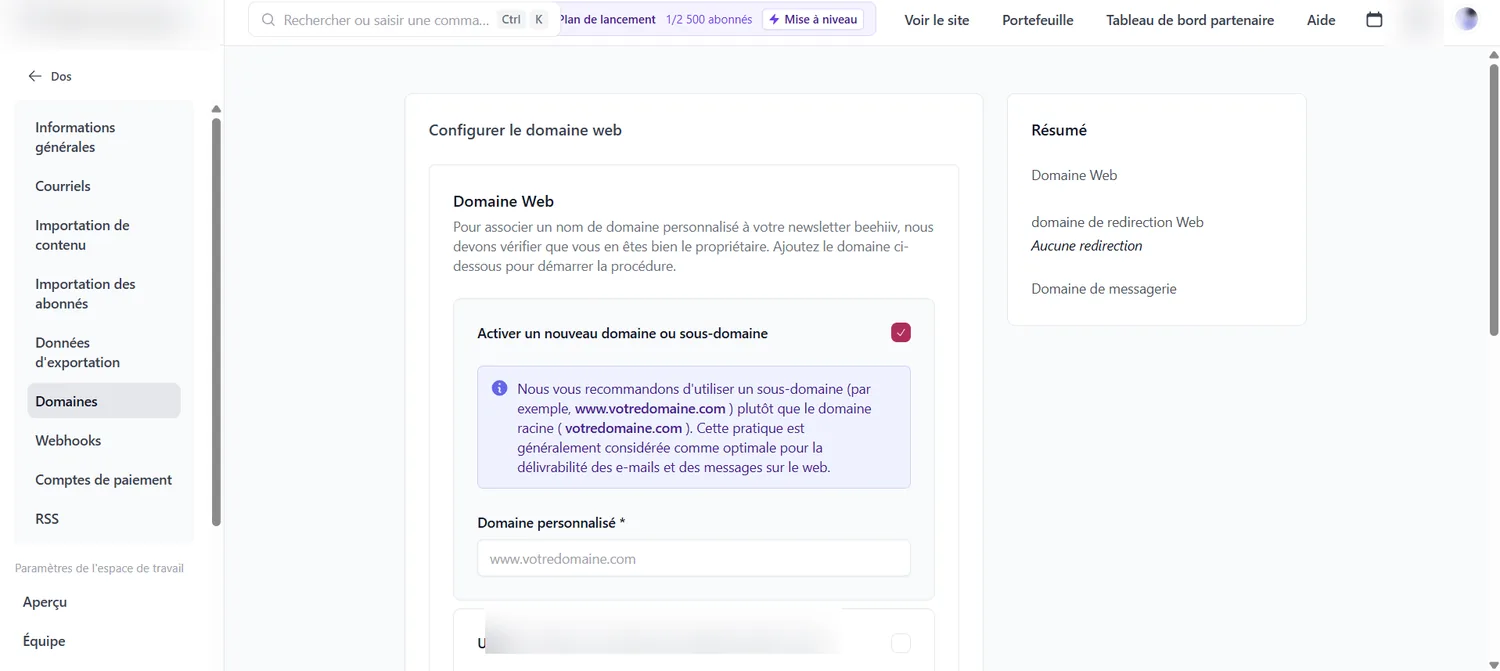
The setup flow distinguishes the website domain, redirect domain and sending domain. Beehiiv recommends subdomain-based configurations in relevant cases, helping keep website publishing and email deliverability concerns separate.
Beehiiv features: what you actually get
Newsletter editor and publishing workflow
The editor handles drafting, formatting, previewing, scheduling and publishing. Its advantage is not that it replaces every specialist writing tool; it is that the finished newsletter, website post and audience data live in the same operating environment.
Website and custom domain
Every publication can have a public web presence. That matters for archives, search visibility, link sharing and giving newsletter content a life beyond the inbox. Custom domains are particularly valuable because you can build brand equity on an address you control instead of treating the publication as a temporary subdomain.
Audience management and segmentation
Beehiiv provides subscriber data, tags/segments and behavioral context that become more useful as the list grows. Segmentation supports the transition from “send the same issue to everyone” toward targeted communication and automation.
Analytics
Campaign and website analytics help answer two different questions: how the newsletter performs in the inbox, and how the publication performs on the web. For a newsletter business, acquisition-source and audience-growth context is often more actionable than looking only at opens.
Surveys, polls and forms
These tools shorten the distance between content and audience research. They can be used to collect preferences, qualify readers or gather feedback that informs future editions and offers.
Podcast support
Beehiiv now presents podcast capability as part of the broader publishing stack, another signal that the product is moving beyond a narrow email-only definition.
Beehiiv growth tools
Growth is one of the clearest reasons to consider Beehiiv over a bare-bones email sender. The platform is designed to make audience acquisition and referral loops native rather than forcing every publication to stitch them together externally.
Recommendation Network
Publications can recommend other newsletters and receive recommendations in return. In 2026, Beehiiv describes the system under a unified Recommendations model that includes both free and paid relationships.
Paid Recommendations (formerly Boosts)
If an older Beehiiv review talks extensively about “Boosts,” note the terminology change. Beehiiv renamed and reorganized this area as Paid Recommendations. The underlying business idea remains familiar: publishers can pay for qualified subscriber acquisition or earn by sending verified subscribers to other publications, depending on the side of the marketplace they use.
Referral program
Recommendations and referrals are not the same thing. Recommendations leverage relationships between publications; a referral program motivates your own readers to invite new subscribers, typically using rewards or milestones.
Acquisition analytics
The value of a growth loop depends on knowing where subscribers came from. Beehiiv's audience and acquisition reporting is therefore more important than the headline presence of a referral feature alone.
How can you make money with Beehiiv?
Beehiiv supports several native revenue models, but the platform does not make an audience valuable automatically. Monetization works when the publication has sufficient attention, trust and commercial relevance.
| Revenue method | How it works | Who it suits |
|---|---|---|
| Paid subscriptions | Readers pay for premium access or a paid tier. | Specialist, research, professional and community-led newsletters. |
| Ad Network | Eligible paid accounts can access advertiser offers inside Beehiiv. | Publishers with consistent sending and an audience advertisers value. |
| Paid Recommendations | Publishers can monetize or acquire subscribers through paid recommendation relationships. | Newsletters participating in the Beehiiv growth ecosystem. |
| Digital products | Sell products directly from the Beehiiv ecosystem. | Creators monetizing expertise beyond the newsletter itself. |
| Sponsorship tools | Higher plans add tools for direct sponsorship operations. | Professional publications selling inventory directly. |
| Community | Create a member discussion layer around the publication. | Audience businesses where access and interaction are part of the value. |
Does Beehiiv take a cut of paid subscriptions?
Beehiiv advertises a 0% platform take rate on paid subscriptions on eligible plans. That does not mean every transaction is fee-free: payment processing charges can still apply. The important distinction is between Beehiiv's platform commission and the processor's transaction cost.
Can Beehiiv pay for itself?
A useful way to evaluate Scale is to convert the subscription into a business hurdle. At a $49 monthly entry price, one $50 sponsorship would roughly cover the software before taxes and other costs. Ten readers paying $5 each would also create $50 in gross subscription revenue before payment processing. These are simple arithmetic examples, not earnings claims; their purpose is to make the subscription decision measurable.
Beehiiv AI in 2026: Agent, MCP and automation
Beehiiv's AI story is now broader than “generate some copy.” The platform has moved toward giving AI controlled access to publication context and, on eligible plans, operational actions.
Beehiiv Agent
The Agent lives inside Beehiiv and can work with publication context. That can reduce the need to copy audience or content information into a separate assistant for every task. The practical value depends on what permissions your plan provides and whether the Agent can complete a meaningful part of your recurring workflow.
Beehiiv MCP
Beehiiv documents Model Context Protocol access for compatible external AI clients. MCP is significant because it lets an external assistant interact with Beehiiv data through a defined tool layer rather than relying on pasted exports. Beehiiv's documentation lists access to areas such as content, subscribers, performance, automations, products, surveys, polls and referrals, with permissions varying by plan.
| Question | Agent | MCP |
|---|---|---|
| Where it runs | Inside Beehiiv | In a compatible external AI client |
| Uses publication context | Yes | Yes, through exposed tools/data |
| Best use | In-product assistance | Connecting Beehiiv to a broader AI workflow |
| Write actions | Plan-dependent | Plan/permission-dependent |
The important buying question is not “Does Beehiiv have AI?” It does. The better question is whether the available permissions remove enough repetitive work from your own publishing process to justify upgrading.
Is Beehiiv good for SEO and AI discoverability?
Beehiiv can support a search-visible publication because newsletter content can live on public web pages under a custom domain, with controls for metadata, indexing and site discoverability. That is meaningfully better for organic discovery than treating newsletters as inbox-only assets.
Current Beehiiv website settings include controls around SEO metadata and indexability, while higher-tier AI bot controls give publishers more say over how AI crawlers interact with their content. That is relevant as publishers increasingly think about both traditional search and answer engines.
Where Beehiiv is strong
- newsletter and web publishing are connected;
- custom domains help consolidate brand authority;
- public archives can create indexable content;
- metadata and indexing controls cover the basics;
- AI crawler controls are now part of the product conversation.
Where it is not a full CMS replacement
A dedicated CMS remains more flexible when you need complex information architecture, extensive custom templates, custom databases, advanced programmatic SEO or deep front-end control. Beehiiv is strongest when the website supports the newsletter business rather than when the website itself is a large custom application.
For a broader strategy beyond the software itself, see our guide to creating content that AI answer engines can cite.
Beehiiv pros, cons and real limitations
What Beehiiv does well
- Strong free starting point: 2,500 subscribers and unlimited sends are enough to validate a real publication.
- Newsletter-first product design: publishing, growth and monetization live together.
- Native growth loops: Recommendations and referrals reduce the need to assemble every acquisition mechanic externally.
- Multiple revenue paths: subscriptions, advertising, recommendations, products, sponsorships and Community.
- Custom domain on Launch: you can build under your own brand before paying.
- Modern AI connectivity: Agent and MCP make the 2026 product more extensible than older reviews imply.
Where Beehiiv falls short
- Free-to-paid jump: moving from $0 to a $49 monthly entry tier is meaningful for a small publication.
- Subscriber-based scaling: software cost rises as the active list grows.
- Advanced operations are gated: several valuable features require Scale or Max.
- Not the deepest CRM: complex lifecycle and sales automation are not Beehiiv's core identity.
- Website flexibility has limits: it is a publication site builder, not an unrestricted CMS framework.
- Growing complexity: the more modules Beehiiv adds, the more there is to learn beyond simply sending a newsletter.
The biggest limitation is also part of Beehiiv's strength
Beehiiv increasingly tries to keep publishing, audience data, growth, monetization, community and AI in one place. That reduces tool fragmentation, but it also means the product is no longer “just a simple newsletter app.” A beginner can publish quickly; mastering the entire operating system takes longer.
Who should use Beehiiv — and who should not?
| User type | Fit | Reason |
|---|---|---|
| Solo newsletter creator | Strong | Free start, simple publishing and clear upgrade path. |
| Independent publisher | Strong | Website, growth, analytics and monetization live together. |
| Media newsletter business | Strong | Multiple revenue tools and higher-tier publishing controls. |
| Creator selling expertise | Strong to good | Subscriptions, products and Community can complement content. |
| B2B company building an owned audience | Good | Useful when the newsletter itself is a meaningful content channel. |
| Complex ecommerce lifecycle marketing | Limited fit | Dedicated ecommerce automation platforms may provide deeper event-driven workflows. |
| Sales-led CRM operation | Limited fit | Beehiiv is a publishing platform, not a full sales CRM. |
| Highly customized web publication | Depends | Evaluate whether Beehiiv's site layer offers enough front-end control for your architecture. |
Beehiiv is especially compelling when…
Your newsletter is not an afterthought. If recurring content is the product, a lead-generation asset or the center of an audience business, Beehiiv's integrated model makes sense because growth and revenue sit close to publishing.
Consider a different type of platform when…
Your priority is sophisticated CRM automation, transactional ecommerce messaging or a deeply custom website. In those cases, forcing Beehiiv to become the center of the stack can be less efficient than choosing software designed around that primary job.
Final verdict: is Beehiiv worth it in 2026?
Yes for the right operating model. Beehiiv is most convincing when you want to build an owned audience and treat a newsletter as a publication or business asset. Launch makes experimentation unusually low-risk, while Scale unlocks the features that turn Beehiiv into a growth and monetization platform rather than only a sending tool.
The main reason not to upgrade is equally clear: if you only need occasional email campaigns, or if your most important workflows live in a CRM or ecommerce automation engine, Beehiiv's strongest features may not solve your central problem.
The best evaluation path is therefore simple: use Launch to publish real content, connect the domain you intend to keep, inspect the analytics and determine which paid feature would materially change your workflow. Upgrade because you need that capability, not because the feature list is long.
Test Beehiiv before paying for the growth stack
Build the publication on Launch first. If automations, monetization or Community become the constraint, you will know exactly why you are upgrading.
Try Beehiiv freeBeehiiv FAQ
Is Beehiiv really free?
Yes. Beehiiv's Launch plan is free for up to 2,500 active subscribers and includes unlimited email sends, a hosted website, custom domains, campaign analytics and the Recommendation Network. Several monetization, automation and community features require a paid plan.
How much does Beehiiv cost?
Beehiiv has a free Launch plan. At the entry subscriber tier, Scale starts at $49 per month when billed monthly and Max starts at $109 per month. Paid-plan pricing increases with the number of active subscribers, so the relevant price is the tier that matches your list size.
Does Beehiiv take a percentage of paid subscriptions?
Beehiiv advertises a 0% platform take rate on paid subscriptions on eligible paid plans. Payment processing fees can still apply, so 0% refers to Beehiiv's platform fee rather than the total transaction cost.
Can you make money with Beehiiv?
Yes. Depending on the plan, Beehiiv supports paid subscriptions, its Ad Network, Paid Recommendations, digital products, sponsorship tools and Community. Revenue is not automatic; the value of these features depends on audience size, engagement and the offer you sell.
Is Beehiiv good for beginners?
Yes for basic publishing. Launch is easy to start with, and the core newsletter workflow is approachable. The learning curve increases when you start using segmentation, automations, growth tools, monetization and the newer AI features.
Does Beehiiv have AI features?
Yes. Beehiiv now includes an integrated Agent and MCP access. MCP can connect Beehiiv data and actions to compatible external AI tools, while the Agent works inside Beehiiv with publication context. Write capabilities depend on the plan.
Does Beehiiv have email automations?
Yes, but publishing automations is a paid feature. In our Launch test account the automation builder was visible, while activation required Scale or Max.
Is Beehiiv good for SEO?
Beehiiv includes a public website, custom domains and controls for metadata, indexing, sitemap and schema-related settings. It can support a search-visible publication, although it is not as extensible as a full CMS for advanced site architecture or custom development.
Can I use my own domain with Beehiiv?
Yes. Custom domains are available, including on Launch. Beehiiv separates website, redirect and sending-domain configuration, which helps keep web publishing and email deliverability concerns distinct.
Who is Beehiiv best for?
Beehiiv is best suited to newsletter-first creators, independent publishers, media teams and businesses building an owned audience around recurring content. It is less compelling when the main need is a complex CRM, ecommerce lifecycle automation or a highly customized website CMS.
Sources and review methodology
We prioritized Beehiiv's current pricing page and official documentation for plan limits and feature behavior, then used our own Launch account to verify what a free user can see in the product. We distinguish documented availability from features we personally accessed. Prices and product names can change, so the official pricing page remains the final source for a purchase decision.