Course creators · Coaches · Marketing agencies
LaunchSpy review: is it worth it for competitor ad and funnel research?
Before you build a course or coaching offer, you may need to find who already advertises in your market and inspect the pages behind their ads. We tested that workflow with Photo Serge, checked the live landing page and reviewed LaunchSpy’s plans.
Our verdict: useful for recurring acquisition research
LaunchSpy is worth considering if your recurring job is to discover course or coaching advertisers and connect their ads to visible offers, funnels and technology. In our session, filters surfaced Photo Serge, an ad opened a linked lead-magnet analysis, and ClickFunnels clues matched the live page. That is a useful research result; it does not validate the competitor’s sales or the entire post-signup sequence.
Choose a plan around the research you actually need. Starter can cover bounded manual work; Pro matters when you need broader analysis or exceed its quotas. Business needs a concrete monitoring or API requirement. For a one-off page check, begin with public or limited access.
What we tested: one focused workflow using seven-day Business access supplied by LaunchSpy for this editorial evaluation. The account operator collected the screenshots; SmartCreatorHub independently inspected the public landing page and its loaded technology resources. We did not buy the creator’s offer, submit its opt-in form, install the extension, test Starter’s access boundaries or connect ChatGPT/Claude. Plan entitlements below come from documentation. This single case does not establish database-wide accuracy.
What is LaunchSpy, and where does it fit before a launch?
LaunchSpy is a competitive intelligence product focused on online knowledge businesses. It brings together creator discovery, recorded Meta ads, public acquisition pages, detected tools and selected organic activity. It answers research questions about other businesses rather than hosting your course or building your own funnel. Product scope: LaunchSpy product information.
Can it help when you do not know the competitors’ names?
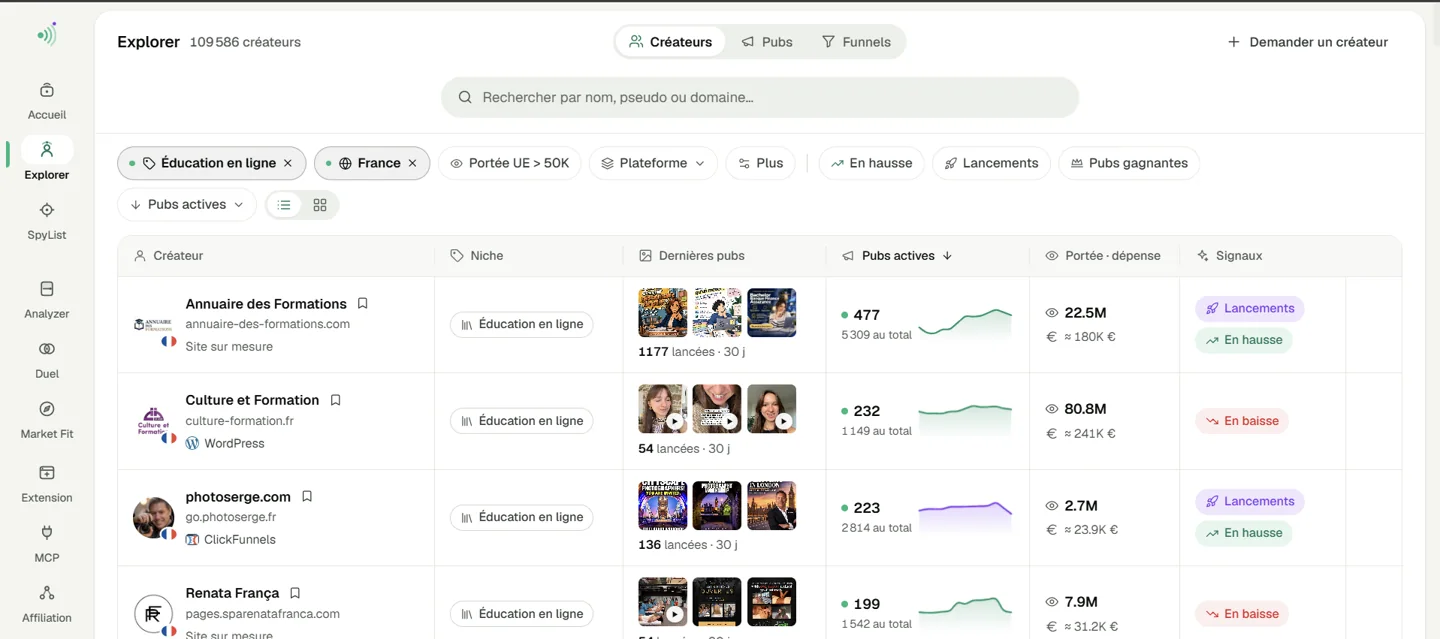
The published filters include niche and country, and our test used that starting point successfully. We selected Online education and France, then opened photoserge.com from the results. The useful output was a named advertiser and an acquisition page to investigate, not a generic list of marketing suggestions.
Keep discovery and validation separate. A result under a France filter does not automatically make every ad French-language or every destination France-only. Our selected ad was English and its funnel was labelled English/Anglosphere. Check the individual record before briefing a country-specific campaign.
LaunchSpy sits upstream of tools such as Thinkific for course creation and delivery and Leadpages for landing-page building. Research can help you form an acquisition hypothesis; it does not establish demand for your own course or choose the right platform on its own.
Our Photo Serge test: from advertiser discovery to a checked landing page
We obtained a concrete lead-magnet example with a supported ClickFunnels technology finding. The test also showed why original pages and record scope need checking alongside the dashboard.
The useful result: a visible acquisition mechanism
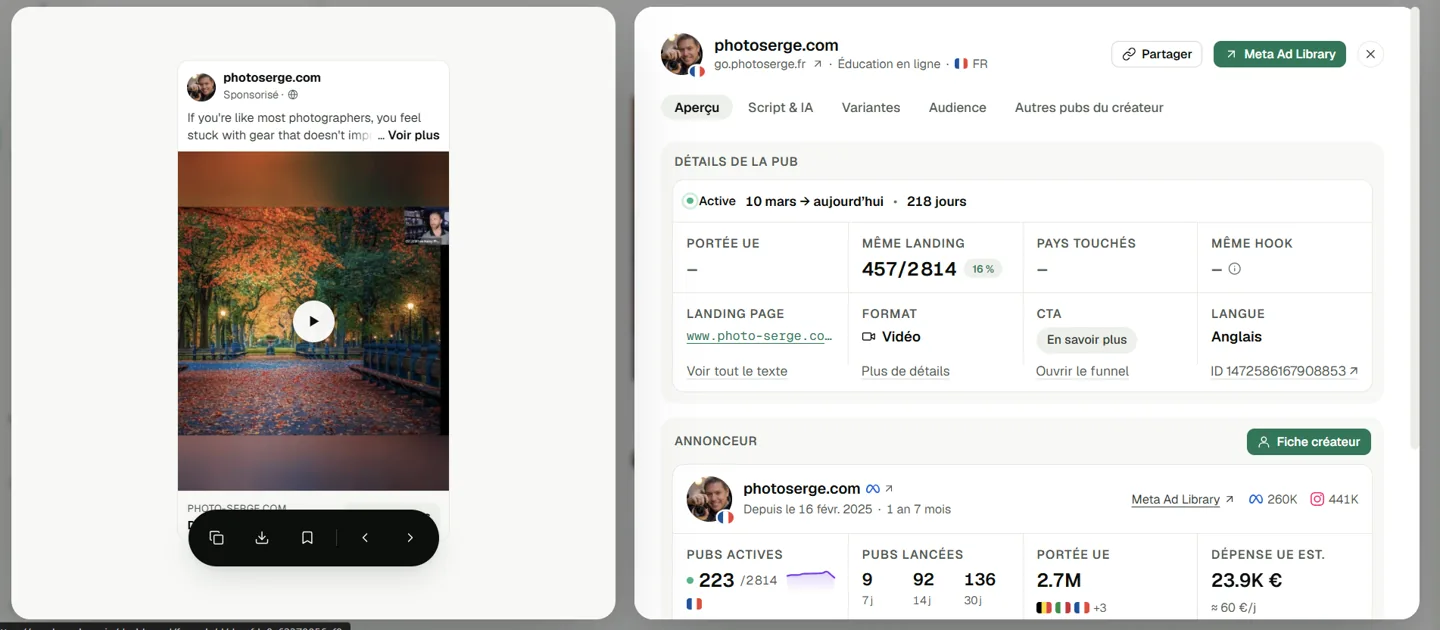
Explorer surfaced Photo Serge after the niche and country selections. In the Ads view, we sorted by longest running duration and opened a landscape-video creative. Its detail panel supplied a landing-page field and an Open funnel action. LaunchSpy linked it to a funnel named Photography Toolbox.
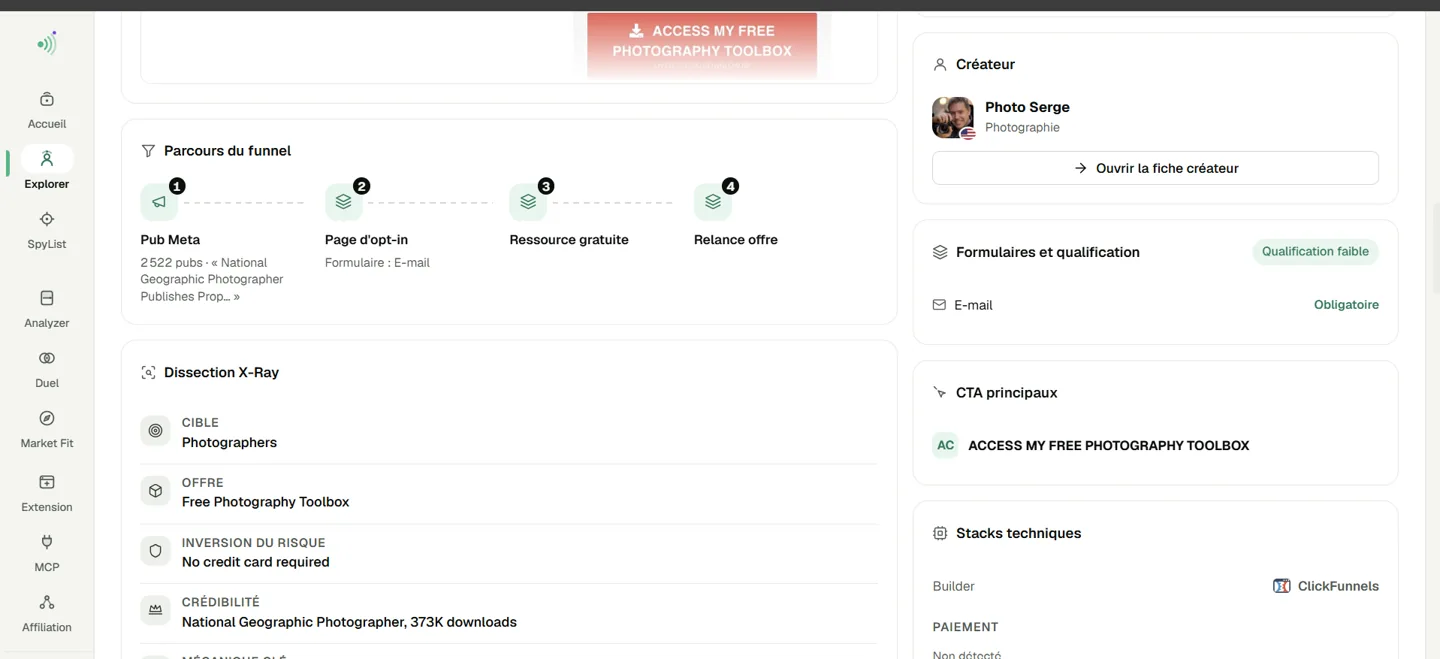
The funnel’s X-Ray classified a lead magnet and extracted a free photography toolbox, an email requirement, a $47 value anchor and no-card wording. The public page we opened did offer a free resource through a first-name-and-email form, with a struck-through $47 amount and no card required. Its detected page-builder label was ClickFunnels.
On the live page, we found a script from app.clickfunnels.com and an image resource from assets.clickfunnels.com. These resources support the ClickFunnels finding for that page. A creator-level WebinarJam label was also visible in the app, but we did not corroborate it on this step.
What that gives a creator planning their own offer
The observation suggests a hypothesis to evaluate: a competitor can put a free resource in front of a paid knowledge business, rather than sending every ad directly to a paid-course page. You can assess whether a genuinely useful introductory resource fits your audience, your follow-up capacity and your economics.
It does not tell you that the same resource would convert for you, what emails arrive next or what the competitor earns. We stopped before signup. The practical research output is a checked acquisition example and a set of unanswered questions, not a proven strategy to copy.
Where the test supports the findings—and where it stops
| Finding | What we checked | What follows |
|---|---|---|
| Free photography toolbox | The live page offered a free resource via a name-and-email form. | The lead-magnet classification matched this public step. |
| ClickFunnels | The page loaded a script and an image asset from ClickFunnels domains. | Concrete clues support the page-builder detection. |
| Resource delivery and offer follow-up | X-Ray displayed those downstream steps; we did not submit the form. | The complete sequence remains unverified. |
| 223 versus 135 active ads | Both totals appeared on different screens during the session. | Scope or freshness needs clarification; the cause is unknown. |
| Estimated EU spend of €23.9K | The creator/advertiser panels displayed an estimate. | It is not verified spend, sales or profit. |
| 20.2K monthly visits | A traffic figure appeared beside the funnel; its exact scope was unclear. | Do not attribute those visits to our selected ad. |
The live destination inspected was Photo Serge’s Photography Toolbox page. Its main photographer headline matched the stored preview, but the URL path differed from the funnel’s displayed path. The preview was labelled analyzed May 15. We did not reconstruct the full redirect chain or claim the entire historical page was unchanged.
LaunchSpy versus Meta Ad Library and manual research: why pay?
The observed advantage was the connected discovery workflow. We could select a niche and country, open a creator’s ads, then reach an associated funnel analysis within the application. The live-page verification still mattered and remained part of the work.
Meta’s public library is a reasonable starting point for checking visible ads. A known competitor’s public landing page can reveal its offer and form without a subscription. LaunchSpy documents additional structured creator and funnel research; paying makes most sense when you repeatedly need that research, rather than merely opening one already-known URL. Official data access: Meta Ad Library API documentation.
You already have one URL
Inspect the page itself or begin with a public detector. Confirm its offer, CTA and visible technical clues. A recurring subscription may be unnecessary for that narrow task.
You need candidates and connected records
Consider LaunchSpy when the recurring job involves finding advertisers, reviewing multiple creatives and acquisition pages, and deciding which records deserve deeper inspection.
LaunchSpy is not the only product researching knowledge businesses. Whoscale and InfoSwipe also describe course/coaching ad and funnel research. Foreplay has creative-research and MCP offerings. Their existence rules out an exclusivity claim; this review does not include a hands-on comparison of those products.
Comparable product scope: Whoscale, InfoSwipe and Foreplay MCP.
We did not measure a time saving against manual research. Assess the value against the research workload you actually repeat, not a claimed number of hours saved or a global database-size figure.
LaunchSpy pricing: choose the plan for the job
The official English terms list Starter at $59, Pro at $99 and Business at $159 per month. Annual plans are prepaid. The English pricing page advertises 25% off and displays rounded monthly equivalents of $44, $74 and $119. Confirm the checkout total rather than multiplying rounded labels into an assumed invoice. Sources: LaunchSpy terms and LaunchSpy pricing.
Bounded manual research
Starter · $59/month
100 distinct funnel pages, 25 X-Rays per month and 3 tracked creators. No MCP, organic research or AI ad analysis.
Regular research
Pro · $99/month
Unlimited funnel pages and X-Rays; 20 tracked creators. Adds organic, AI ad analysis, transcripts, EU reach and MCP.
Broader monitoring
Business · $159/month
Unlimited tracked creators, more MCP credits and 5 API keys rather than Pro’s 1.
Which plan fits these concrete research requirements?
| Your requirement | Plan to consider | Reason |
|---|---|---|
| Manual research below 100 distinct pages and 25 X-Rays a month | Starter | Fits these quotas if you do not need Pro-only functions; tracking is limited to 3 creators. |
| 150 distinct pages or 35 X-Rays each month | Pro | Either requirement exceeds Starter. These are planning examples, not measured usage from our test. |
| AI ad-copy analysis, video transcripts or organic research | Pro | These functions are excluded from Starter, regardless of a small page count. |
| MCP access for an AI assistant | Pro or Business | Starter does not include MCP. |
| Monitor 25 creators concurrently | Business | Pro’s published tracking allowance is 20 creators; Business removes that limit. |
Our recommendations apply the published limits to illustrative requirements. We did not verify the paywall at each plan boundary. The temporary Business access supplied for our test does not mean you need Business to perform all manual research.
Funnel X-Ray is not the same as AI ad analysis
Starter includes a limited number of X-Rays, while the pricing table excludes its AI ad-analysis feature. The features page defines ad analysis around hooks, angles, offers and CTAs. This distinction matters if you want landing-page analysis but do not need the separate ad-copy or MCP functions.
The documented limits refer to distinct funnel pages and X-Ray analyses, not just creator profiles. Page Analyzer counts as an X-Ray. Unlimited ad access does not make every downstream research operation unlimited. Definitions: LaunchSpy feature definitions.
Use the pricing page for your market. The French page shows different currency and discount options; we have not established that changing the language guarantees a different checkout entitlement. This review’s prices refer to the English USD offer.
Is LaunchSpy free? Choose the right entry point
The free account is limited access, not a standard seven-day trial. The pricing FAQ describes 5 creators and 2 profiles. Our Business period was supplied for an editorial evaluation and should not be presented as an offer available to every signup.
- Limited account: explore whether the product is relevant before subscribing.
- Public stack detector: the separate web tool advertises URL analysis without an account or card.
- Chrome extension: the pricing FAQ describes a free verdict, with additional research behind paid access.
We did not test the logged-out detector or install the extension. The entry points and their restrictions should not be combined into one “everything is free” claim. Public tool: LaunchSpy free stack detector.
Does LaunchSpy show actual sales, spend or profitability?
Our test did not establish actual sales, conversions, ROAS or profit. The platform supplies advertising activity and interpreted public signals. Its terms explicitly distinguish inferred estimates and classifications from audited financial data.
EU reach and estimated spend answer different questions
Meta’s API documentation calls EU reach estimated and limits its public spend field to political and issue ads. Do not interpret a commercial advertiser’s estimated budget in LaunchSpy as an exact expense disclosed by Meta. The source of a public reach signal and a vendor’s spend estimation are distinct.
In our case, €23.9K was labelled estimated EU spend. Without the actual campaign costs and attributed revenue for a defined period, it cannot establish profitability. Similarly, the 20.2K monthly-visit figure beside the funnel did not establish visits from the selected ad.
Ad age is useful for triage, not proof of uninterrupted profitable delivery
The inspected ad was labelled active, March 10 to today, with 218 days. We did not examine a daily delivery log. Report this as the displayed ad-age information; do not claim 218 uninterrupted days of spend or positive returns. Use it to select a record for further research.
Keep record counts and page freshness attached to their context
Explorer and the ad-detail advertiser block showed 223 active ads and 2,814 total. The creator overview and Ads tab showed 135 active and 2,725 total. We do not know whether this came from scope, filters or refresh differences. It merits clarification before relying on a single total.
X-Ray also interpreted promotional copy. Its credibility field repeated a National Geographic association and 373K downloads; we did not authenticate either. The offer’s free-today wording appeared in the May preview and October live page, so that wording alone did not demonstrate an actual expiry today. Such observations show why the original page should accompany the interpretation.
Can you use LaunchSpy with ChatGPT or Claude?
LaunchSpy documents a read-only MCP server for Pro and Business, with OAuth instructions for compatible chat clients. We did not connect it in this test. Manual research in the app did not require an AI connection.
The MCP FAQ lists 10,000 monthly credits on Pro and 50,000 on Business, doubled with annual billing. The annual pricing view shows 20,000 and 100,000. The features page defines one credit as one call; the FAQ uses “question.” A message involving several calls should not be assumed to cost exactly one credit.
Capabilities and allowances: LaunchSpy MCP documentation. Confirm the cadence and allowance in your account. Returned-answer quality, consumption and client-specific setup were not evaluated. A detailed installation walkthrough is outside this review’s scope.
Who should subscribe to LaunchSpy?
A good reason to evaluate it
You launch courses or coaching, or research those businesses for clients. You regularly need advertising candidates and connected acquisition records, and will verify meaningful findings against their sources.
A reason to begin with limited access
You only need one page’s technology, have a one-off research task, or have not yet found relevant advertisers. First determine whether its records match your actual market.
Our strongest positive observation is that the discovery-to-funnel workflow produced a real offer we could inspect and a technology clue we could corroborate. Our reservation is that the dashboard and X-Ray should not be treated as a validated account of the competitor’s complete business performance.
Check your market before choosing a subscription
Find a relevant advertiser, inspect a source page and decide whether the work you repeat needs paid access. Use the plan’s actual limits to make that decision.
LaunchSpy review: answers before buying
Is LaunchSpy worth it for course creators and coaches?
It is worth considering when you repeatedly research competitor advertising and acquisition funnels. Our test linked a Photo Serge ad to a real email-capture page and corroborated ClickFunnels clues. It did not establish sales or profitability. Occasional researchers may get enough from public pages and limited access.
Can LaunchSpy help me discover competitors without knowing their names?
Its published filters include niche and country. In our session, Online education and France surfaced Photo Serge, which we then inspected. That is one observed discovery example; it is not a completeness test of every competitor in a market.
Can I research funnels without connecting LaunchSpy to ChatGPT?
Yes. Our session used the web application to browse creators, inspect an ad and open its linked funnel and X-Ray. No MCP connection was made. MCP is an optional access route with its own plan requirements.
Does Starter include Funnel X-Ray or AI ad analysis?
The pricing table lists 25 Funnel X-Rays per month on Starter, but excludes AI ad analysis and MCP. Funnel-page analysis and AI analysis of ad hooks, angles and copy are separate entitlements. Pro adds the latter functions.
How much does LaunchSpy cost?
The official English terms list Starter at $59, Pro at $99 and Business at $159 per month. Annual plans are prepaid. Check the selected currency, billing cadence and final checkout amount before subscribing.
Is LaunchSpy free, and is there a seven-day free trial?
The pricing FAQ describes a limited free account instead of a standard free trial. Our seven-day Business access was arranged for this editorial evaluation, not a public trial offer. The public URL stack detector is a separate entry point.
Does Page Analyzer use my X-Ray quota?
Yes. The official feature definitions state that each Page Analyzer analysis counts as one Funnel X-Ray. The separate distinct-funnel-page limit should also be considered when planning Starter usage.
Can LaunchSpy show a competitor’s actual sales or ROAS?
This test did not reveal actual sales, conversions or ROAS. Activity, ad age, reach and estimated spend can guide research, but they do not establish profitability. LaunchSpy’s terms describe financial estimates and classifications as inferred public-signal data.
Why are MCP allowances shown as 10,000 and 20,000?
The MCP FAQ describes 10,000 monthly credits on Pro and 50,000 on Business, doubled with annual billing. The annual pricing view displays 20,000 and 100,000. The feature definitions say one credit is one call; one conversation message may require several calls.
Does a detected ClickFunnels label prove the creator hosts their course there?
No. We corroborated ClickFunnels resources on the inspected landing page. That supports a page-technology finding, not a claim about where all courses, payments or webinar delivery are hosted.
Sources, evidence and scope
Official documentation was checked on October 14, 2026. The three screenshots document our single-case session. The linked public landing page and its loaded resources supply the independent page-level checks. Documentation, app observations and our judgments are identified separately throughout the review.
- LaunchSpy pricing — offer, quotas and free-access wording.
- LaunchSpy feature definitions — definitions of pages, X-Rays and calls.
- LaunchSpy MCP documentation — documented AI access and allowances.
- LaunchSpy terms — monthly USD prices and interpretation of estimates.
- LaunchSpy free stack detector — separate public URL tool.
- LaunchSpy product information — product purpose and coverage.
- Meta Ad Library API — reach and spending fields.
- Photography Toolbox landing page — inspected offer and form.