Infomaniak Review 2026: Swiss Hosting, kDrive, Email, kSuite, Pricing & Trade-offs
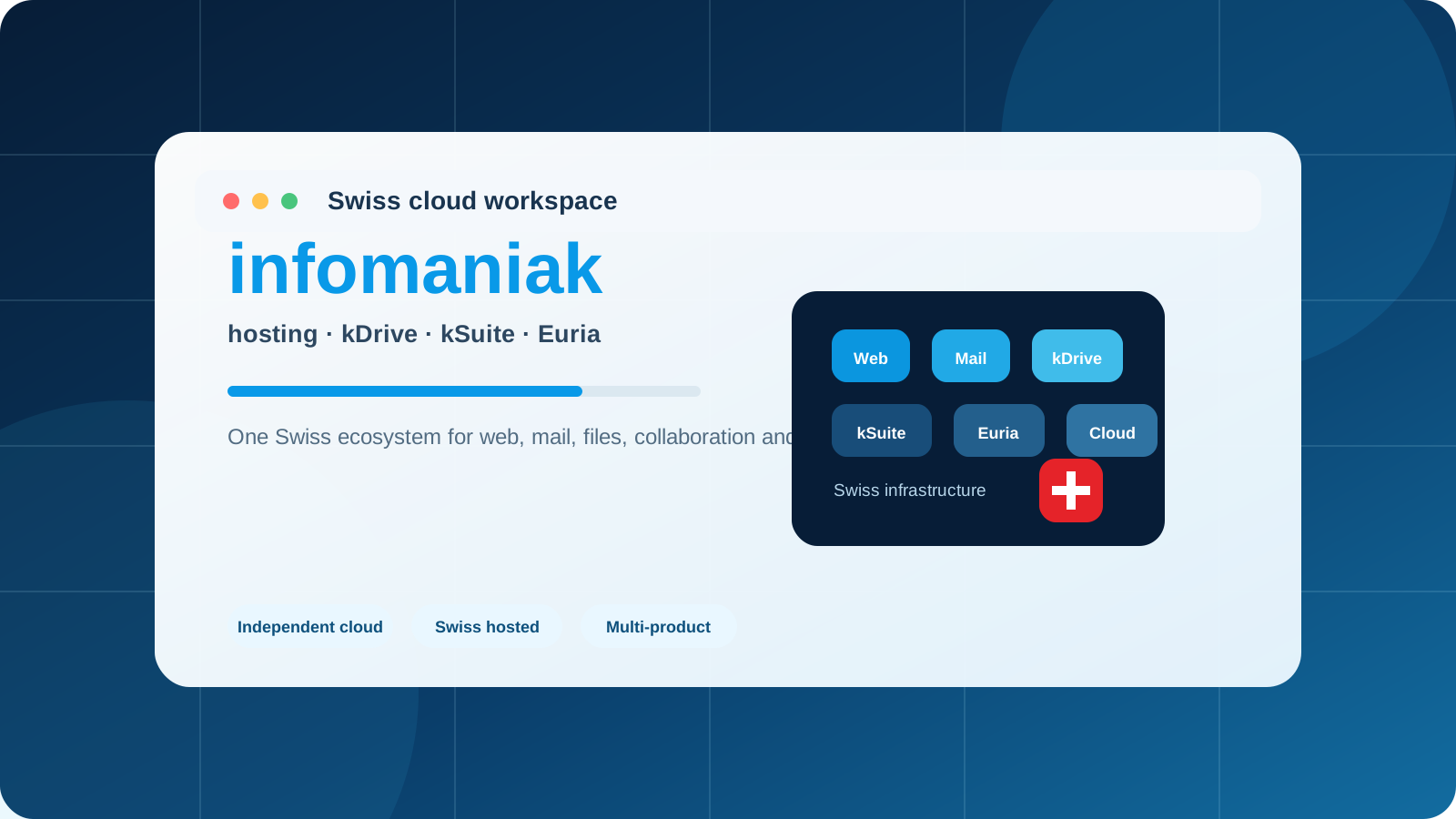
Infomaniak is no longer just a Swiss web host. It combines web hosting, professional email, kDrive storage, kSuite collaboration, SwissTransfer, Public Cloud and sovereign AI through Euria. Our October 2026 review finds the strongest value in consolidating several services under one Swiss provider — but the stack should still be judged product by product. kSuite and kDrive are unusually aggressive on storage value, hosting is resource-rich, and Public Cloud is a more specialized infrastructure option rather than a full replacement for AWS, Azure or GCP.
Quick verdict
Infomaniak is best understood as a Swiss cloud ecosystem, not a single hosting product. It is particularly compelling for European teams that want hosting, email, storage and collaboration with Swiss data residency and fewer US vendors. It is less compelling if you need hyperscaler-level service breadth, a globally distributed hosting footprint or deep dependence on Google/Microsoft-native workflows.
The key question is not “is Infomaniak the best host?” It is how much of your stack can it replace without creating new workflow compromises?
What is Infomaniak?
That definition matters because English-language reviews often reduce Infomaniak to “Swiss hosting.” In 2026, the company is better compared to a partial digital-stack alternative: hosting can compete with Hostinger or OVHcloud; kSuite competes with parts of Google Workspace and Microsoft 365; kDrive with Google Drive or Dropbox; SwissTransfer with WeTransfer; and Public Cloud with selected workloads on hyperscalers.
Sources: Infomaniak hosting, Euria.
Which Infomaniak product do you actually need?
| Need | Infomaniak product | Best fit |
|---|---|---|
| WordPress or business website | Web Hosting | Shared hosting with generous storage and multi-site capacity. |
| More demanding app/site | Managed Cloud Server | Guaranteed resources and advanced server technologies. |
| Business email + collaboration | kSuite | Email, kDrive, calendar, contacts, chat and documents. |
| Cloud storage only | kDrive | 3 TB+ plans, desktop/mobile sync and online editing. |
| Personal cloud/email | my kSuite | Free or low-cost personal stack. |
| Large file transfer | SwissTransfer | Up to 50 GB per transfer on the current service. |
| Infrastructure | Public Cloud | OpenStack-based compute, storage and managed services. |
| Sovereign AI assistant | Euria | AI with Swiss-hosted infrastructure and kSuite integrations. |
Infomaniak Web Hosting: a strong multi-site offer, not a bargain-bin host
Current Web Hosting starts at CHF 10.91/month. Infomaniak lists 20 sites included by default, 250 GB SSD storage, unlimited traffic, FTP/SSH, one email address with your domain, Let’s Encrypt SSL, DDoS protection and daily backups with seven-day retention.
The value becomes much easier to understand if you run several sites. For one tiny brochure site, a low-cost host may be cheaper. For an agency, freelancer or multi-project owner, the included storage and site allowance can make the economics more attractive.
Strong points
- 20 sites by default, expandable further.
- 250–650 GB SSD depending on configuration.
- SSH and unlimited traffic.
- WordPress and 100+ CMS/application options.
- Daily backups stored in another Infomaniak data center in Switzerland.
Trade-offs
- Not the cheapest entry point for one small site.
- Domains are billed separately.
- Swiss-only hosting infrastructure can add latency for predominantly US/Asia audiences unless a CDN is used.
- Advanced Node.js/Redis/MongoDB workloads push you toward managed cloud.
Source: Infomaniak hosting pricing/features.
Managed Cloud Server: the step above shared hosting
The Managed Cloud Server currently starts at CHF 38.41/month and scales from 4 to 32 vCPU, 12 to 128 GB RAM and up to 3 TB NVMe storage depending on configuration. Infomaniak advertises up to 400 websites and 99.99% availability for this product line.
This is a very different purchase from the standard Web Hosting plan. It is better suited to agencies, ecommerce, high-traffic WordPress, resource-heavy applications and teams that want stronger isolation without taking on a fully self-managed VPS.
Source: Infomaniak — Managed Cloud pricing.
Email and kSuite: where Infomaniak becomes unusually competitive
kSuite Standard is currently displayed at CHF 1.76 per user/month on the French pricing surface, with two professional email addresses per user, unlimited email storage and 50 GB kDrive storage per user. Higher tiers add more addresses, storage and collaboration features.
One important correction to older “no promo pricing” narratives: Infomaniak now advertises 50% off the first year on some Business and Enterprise kSuite plans. Flat pricing remains true for some products, but it is no longer safe to generalize that Infomaniak never uses introductory discounts.
my kSuite: one of the easiest entry points into the ecosystem
This matters because you do not need to move a company website or buy business hosting to test the broader Infomaniak experience. For an individual user, freelancer or very small business, my kSuite is a lower-friction way to evaluate Mail, kDrive, calendar, contacts and Euria before committing to a larger stack.
Source: Infomaniak — my kSuite pricing.
kDrive: compelling storage economics, but check workflow details
kDrive Solo currently starts at CHF 4.99/month for 3 TB, Team at CHF 10/month and Pro at CHF 6.66 per user/month. It supports Windows, macOS, Linux, iOS and Android, plus WebDAV and selected NAS integrations.
For users moving from Google Drive or Dropbox, the biggest attractions are storage value, Swiss hosting and the broader kSuite ecosystem. But migration decisions should be workflow-specific: search behavior, external sharing, integrations, document collaboration and admin controls can matter more than headline terabytes.
Source: kDrive pricing and features.
For pure storage economics, kDrive is one of the strongest parts of the Infomaniak stack. The more your workflow depends on Google-native add-ons, Microsoft-centric document processes or niche third-party connectors, the more important a real migration test becomes.
SwissTransfer: useful ecosystem glue
SwissTransfer currently supports files up to 50 GB per transfer, with password protection and configurable retention. Infomaniak positions it as an ad-free Swiss-hosted transfer service.
It is not a reason to buy Infomaniak by itself. It is useful because it removes another separate tool from the stack — exactly the consolidation story that makes the broader ecosystem attractive.
Source: SwissTransfer.
Euria: sovereign AI is now a real part of the Infomaniak stack
Euria is Infomaniak’s AI assistant. The company says it runs on its own infrastructure in Switzerland, uses open-source models, does not use user data to train models and integrates with parts of kSuite. Its current features include web-assisted answers, writing, translation, transcription, document analysis and collaboration integrations.
A key limitation: availability depends on the plan and context. For example, Infomaniak documents Euria-on-kDrive as unavailable on several entry-level kSuite/kDrive plans. “Euria included” should not be interpreted as every AI feature being available on every tier.
Sources: Euria, Euria support guide.
Euria vs ChatGPT: not a one-for-one replacement
Euria should be understood as Infomaniak’s sovereign AI layer inside its productivity ecosystem. That makes it strategically interesting for users who care about Swiss-hosted processing and tighter integration with Infomaniak services. ChatGPT, Claude and Gemini still have broader standalone ecosystems, model choices and advanced workflows. The right comparison is therefore data-control and stack integration versus breadth of AI capabilities.
Public Cloud: attractive OpenStack economics, not a full AWS clone
Infomaniak’s Public Cloud is OpenStack-based and billed on usage. Its current pricing page advertises CHF 300 of starting credit and publishes comparisons against AWS, Azure, Google Cloud and OVHcloud.
Those comparisons are Infomaniak’s own calculations, not independent benchmarks. They are useful for understanding positioning, but they should not be treated as proof that every workload is cheaper.
Source: Public Cloud pricing.
For production architecture, compare the exact managed services you use today rather than comparing only VM pricing. A workload built mostly on virtual machines, object storage and Kubernetes is much easier to move than one deeply tied to proprietary hyperscaler services.
Infomaniak pricing in 2026
Verified pricing reference — October 2, 2026
Use these as orientation points, not permanent list prices. Promotions and plan details can change.
| Product | Current advertised price | What to know |
|---|---|---|
| Web Hosting | from CHF 10.91/mo | 20 sites, 250 GB SSD by default. |
| Managed Cloud Server | from CHF 38.41/mo | Guaranteed resources, up to 32 vCPU / 128 GB RAM. |
| kSuite Standard | CHF 1.76/user/mo | Business email + 50 GB kDrive/user. |
| kSuite Business | CHF 3.67 then 7.33/user/mo | Current first-year discount on the relevant pricing page. |
| kSuite Enterprise | CHF 6.92 then 13.83/user/mo | Current first-year discount. |
| Mail Service | from CHF 2.29/mo | Standalone mail product. |
| kDrive Solo | from CHF 4.99/mo | 3 TB, one user. |
| kDrive Team | from CHF 10/mo | Six users included. |
| kDrive Pro | CHF 6.66/user/mo | Advanced collaboration/admin. |
Pricing is in Swiss francs and can vary with commitment length, storage and configuration. Always verify the checkout price for your exact region and plan.
Infomaniak vs the alternatives
Infomaniak vs Google Workspace
Choose Infomaniak when Swiss data residency, bundled storage and vendor sovereignty matter more than Google’s ecosystem breadth. Choose Google Workspace when deep integrations, real-time collaboration maturity and global familiarity dominate.
Infomaniak vs Microsoft 365
Microsoft remains stronger for organizations centered on desktop Office, Teams, Entra and Microsoft enterprise tooling. Infomaniak is more attractive for a compact Swiss stack; higher kSuite tiers also support Microsoft Office Online editing.
Infomaniak vs Hostinger
Hostinger is primarily a hosting/site-builder proposition. Infomaniak combines hosting with email, cloud storage, collaboration, transfer and AI. For one inexpensive site, Hostinger may be simpler; for stack consolidation, Infomaniak has the more distinctive proposition.
Infomaniak vs OVHcloud
Both are major European alternatives to US cloud providers, but OVHcloud has a broader infrastructure footprint while Infomaniak blends hosting and productivity services more tightly. Compare the exact workload instead of looking for a universal winner.
Is Infomaniak good for US-first websites?
It can work, especially with a CDN, but the natural infrastructure geography is Europe/Switzerland. A site whose audience, application servers and third-party services are primarily in North America should measure latency rather than assume a Swiss origin is optimal.
Pricing stability: check the exact product
Infomaniak is often praised for avoiding extreme “cheap first term, expensive renewal” hosting tactics, but that should not be generalized across every 2026 product. Some kSuite Business and Enterprise offers use first-year promotional pricing. Our rule is simple: compare the current renewal figure, not only the headline entry price.
Swiss privacy and data residency: meaningful, but not magic
Infomaniak emphasizes Swiss jurisdiction, Swiss-operated infrastructure and GDPR/FADP compliance across key services. This meaningfully changes where data is processed and which provider controls the infrastructure. It does not eliminate your own GDPR responsibilities or automatically make every workload compliant.
On sustainability, Infomaniak’s own impact report states an average data-center PUE of 1.085 in 2024 and says 65% of the electricity consumed by its newest data center was recovered as heat in 2024. These are first-party environmental metrics, so they should be cited as Infomaniak-reported data rather than converted into an unsupported “greenest host” ranking.
Source: Infomaniak impact report.
Sustainability: unusually detailed reporting, but still first-party data
Infomaniak says it has used outside-air cooling for years and extends server hardware life significantly rather than replacing machines on short cycles. Its newest data-center design also recovers waste heat for local use. For buyers with sustainability requirements, this level of public operational detail is a meaningful differentiator.
The limitation is methodological: PUE, heat recovery and hardware life do not by themselves prove the total carbon footprint is lower than every competitor. Electricity mix, embodied hardware emissions, utilization and customer workload efficiency all matter. Treat Infomaniak’s impact report as evidence of a serious environmental strategy, not as an automatic “greenest cloud” verdict.
Source: Infomaniak — impact report.
Support quality and current limitations
Infomaniak advertises seven-day hosting support and multiple contact channels. Recent public feedback is mixed: some customers praise problem resolution and technical competence, while others criticize Manager complexity, slower support cases or UX friction. Trustpilot and Reddit are useful signals, but neither should be treated as representative of all customers.
For Web Hosting, Infomaniak currently advertises support seven days a week, with phone/written availability generally spanning 6 a.m. to 9 p.m. Swiss time for the published hosting support window. Exact hours and priority can vary by product and contract.
What stands out
- Strong multi-service consolidation.
- Competitive kSuite and kDrive economics.
- Generous multi-site hosting.
- Clear Swiss data-residency positioning.
- Euria adds a real 2026 differentiator.
Where to be cautious
- Manager/product breadth can increase complexity.
- No global hosting data-center footprint like hyperscalers.
- Public Cloud is narrower than AWS/GCP/Azure proprietary ecosystems.
- AI feature availability varies by plan.
- Some product lines now use first-year promotional pricing.
One Infomaniak ecosystem or separate best-of-breed tools?
This is the real buying decision. Infomaniak becomes more valuable when it replaces several subscriptions or vendors at once. If you only need one specialized function, a dedicated provider may still be better.
| Decision factor | Infomaniak ecosystem | Separate specialist tools |
|---|---|---|
| Accounts & billing | More consolidated | Fragmented across vendors |
| Data residency | Strong Swiss positioning | Depends on each provider |
| Feature depth | Broad stack, uneven by product | Often deeper in each niche |
| Integration breadth | Good inside the Infomaniak stack | Often broader for Google/Microsoft ecosystems |
| Vendor dependency | Higher concentration with one provider | More vendors, less single-provider concentration |
| Operational simplicity | Usually stronger | More admin overhead |
The SmartCreatorHub Infomaniak Stack Test
1. How many vendors can you consolidate?
Hosting + email + drive + collaboration creates strong value. One isolated service creates less differentiation.
2. Does Swiss data residency matter?
If yes, Infomaniak becomes much more distinctive. If not, compare purely on feature depth and price.
3. Do you need a global ecosystem?
Google, Microsoft and AWS still have broader third-party ecosystems and global footprints.
4. Where is your audience?
Europe is the natural hosting fit. Predominantly US/Asia traffic should be tested with a CDN and latency measurements.
5. Are you trying to reduce US-vendor dependency?
This is one of Infomaniak’s strongest strategic use cases.
Interpretation
Strong fit: European SMBs, freelancers, multi-service teams. Conditional: global/complex cloud. Weak: one highly specialized best-of-breed need.
Who should use Infomaniak?
Best fit: privacy-conscious European businesses, agencies with several websites, teams wanting email + storage + collaboration, and buyers deliberately seeking a Swiss alternative to parts of the US cloud stack.
Less obvious fit: US-first performance workloads, companies deeply locked into Microsoft/Google enterprise workflows, and cloud architectures built around proprietary hyperscaler services.
Our conclusion: a compelling Swiss stack, best evaluated product by product
Infomaniak’s biggest advantage in 2026 is breadth with a coherent Swiss infrastructure story. Hosting, email, kDrive, kSuite, SwissTransfer and Euria can cover a surprisingly large share of a small business or freelancer’s digital stack without defaulting to US hyperscalers.
The trade-off is equally important: broad does not mean universally best. Google and Microsoft still offer deeper enterprise ecosystems, hyperscalers expose many more managed cloud services, and specialist storage or hosting vendors may fit some workflows better.
Infomaniak FAQ
Is Infomaniak safe?
Infomaniak operates a mature Swiss cloud business and documents security, backups and data-residency practices. “Safe” still depends on your configuration, threat model and compliance requirements.
Is Infomaniak a Swiss company?
Yes. Infomaniak is based in Switzerland and positions its core staff and data-center infrastructure in Switzerland.
Where does Infomaniak store data?
Infomaniak states that key services run on infrastructure in Switzerland. Check the exact service documentation if contractual data location is critical.
Is Infomaniak GDPR compliant?
Infomaniak states that relevant services comply with GDPR and Swiss FADP requirements. Customers still remain responsible for their own compliance obligations.
How much does Infomaniak cost?
As of October 2026, Web Hosting starts at CHF 10.91/month, kSuite Standard at CHF 1.76/user/month and kDrive Solo at CHF 4.99/month.
Is Infomaniak good for WordPress?
Yes. Its Web Hosting includes WordPress installation support, SSD storage, SSH, backups and unlimited traffic.
Is kDrive a Google Drive alternative?
Yes for storage, sync, sharing and document editing, but you should compare integrations and collaboration workflows before migrating.
Is kSuite a Google Workspace alternative?
It can replace the core email/storage/collaboration stack for many teams, but not every Google Workspace integration or workflow.
What is Euria?
Euria is Infomaniak’s sovereign AI assistant, hosted on Swiss infrastructure according to the company and integrated into parts of kSuite.
Is SwissTransfer free?
Yes. A free tier currently supports transfers up to 50 GB, with paid options adding more business features.
Is my kSuite free?
Yes. Infomaniak currently offers a free my kSuite tier with 20 GB of email storage and 15 GB of kDrive. my kSuite+ adds more storage and features from CHF 1.60/month on annual billing as of October 2, 2026.
Can Infomaniak replace Google Workspace?
For many small teams, kSuite can replace core email, storage, calendar, chat and document workflows. It does not reproduce every Google Workspace integration, automation or third-party ecosystem.
Can Infomaniak replace AWS?
Not completely. Infomaniak Public Cloud covers IaaS, OpenStack, Kubernetes, storage and GPU workloads, but AWS offers a much broader catalog of managed and proprietary cloud services.
Is Infomaniak good for US websites?
It can be, particularly with a CDN, but its natural infrastructure geography is Switzerland/Europe. US-first sites should test latency and origin performance before migrating.
Does Infomaniak use renewable energy?
Infomaniak publishes environmental reporting on electricity, PUE, server life and heat recovery. Use its impact report for the current energy mix and methodology rather than relying on a generic “green hosting” label.
Sources and review method
Last verified October 2, 2026. Product pricing and features can change. Every Infomaniak source link below preserves its specific destination and adds our affiliate ID as a suffix.
- Infomaniak — Web Hosting pricing/features
- Infomaniak — Mail and kSuite pricing
- Infomaniak — kDrive pricing
- Infomaniak — Euria
- Infomaniak — Euria support guide
- Infomaniak — Public Cloud pricing
- Infomaniak — AI Services
- Infomaniak — SwissTransfer
- Infomaniak — impact report
- Digital Hosting — Infomaniak Review, Sep. 2026
- Trustpilot — public Infomaniak reviews
First-party pricing and sustainability claims are labelled as Infomaniak data. Public user reviews are used as anecdotal signals, not as representative customer-satisfaction measurements.