Global HR · Employer of Record · Payroll · Contractors
Deel review 2026: pricing, EOR costs, contractors and real limitations
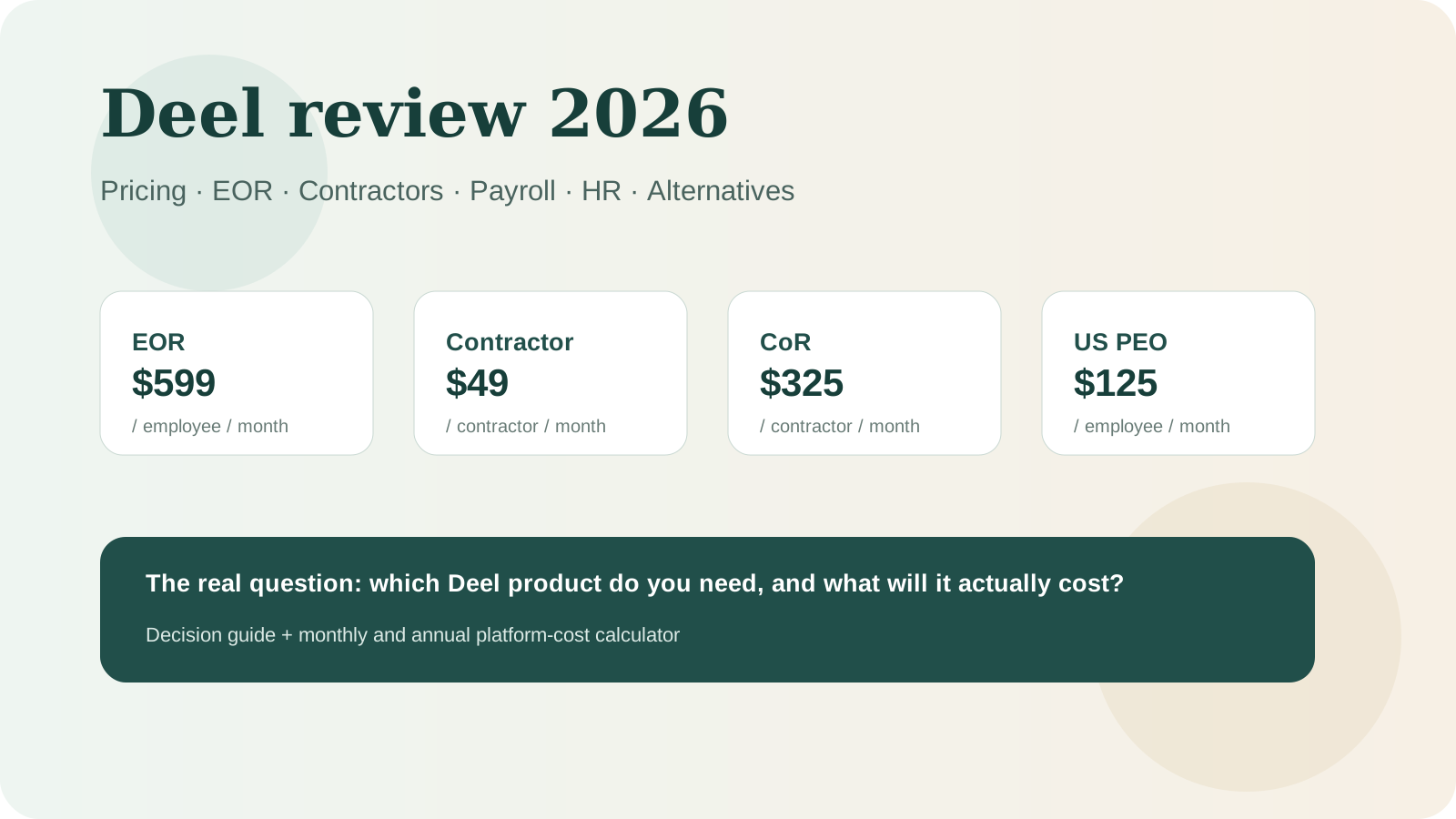
Our take: Deel makes the most sense when a company has a genuine cross-border employment problem and wants employer of record, contractors, payroll and HR in one system. The breadth is the advantage. The trade-off is cost: a $599 EOR fee or $49 contractor fee compounds quickly as headcount grows, so the right question is not simply whether Deel is good, but which Deel product you actually need and what the annual platform cost will be.
Deel is a broad global-employment platform, not a single payroll product. It can hire employees through EOR where you do not own a local entity, manage international contractors, run payroll where you do own entities, and provide HRIS functions. The platform is strongest when those needs overlap. If your team is local and your problem is simple, Deel can be more platform than you need.
Which Deel product fits your situation?
The easiest way to understand Deel is to start from the employment problem, not the product list. EOR, Contractor, Contractor of Record, Global Payroll and HR solve different problems. Choosing the wrong layer can make Deel look either unnecessarily expensive or incomplete.
Use case: Deel EOR. Deel becomes the legal employer while the person works day to day for your company.
Use case: Deel Contractor. The platform centralizes contracts, invoices and payments.
Use case: Contractor of Record. It costs more and requires a one-month contractor-pay deposit.
Use case: Global Payroll. This is payroll infrastructure, not EOR.
Use case: Deel HR. Core HR starts at $5 per employee per month.
Use case: US PEO, subject to fit and eligibility.
Product scope and public prices checked against Deel's official pricing and product documentation on September 20, 2026.
What is Deel?
Deel is a global workforce platform that combines international employment, contractor management, payroll, HR and talent products. That breadth matters because an international team rarely has only one worker type. A company may have direct employees in countries where it owns entities, EOR employees in countries where it does not, and contractors across additional markets.
The useful distinction is this: EOR is a legal-employment service, Global Payroll is payroll for entities you already own, Contractor is a contractor-management layer, and Deel HR is an HRIS/HCM layer. Treating them as one product is the fastest way to misunderstand Deel's pricing.
How much does Deel cost in 2026?
Deel does not have one price. It publishes product-level pricing, and the number that matters depends on whether you are hiring, paying, employing or simply managing people data.
| Deel product | Published starting price | What it solves |
|---|---|---|
| Talent | $14 / worker / month | Candidate sourcing, screening and recruiting workflow |
| Contractor | $49 / contractor / month | International contractor management and payments |
| Contractor of Record | $325 / contractor / month | Deel takes on more classification and engagement responsibility |
| Employer of Record | $599 / employee / month | Hire employees where you do not own a legal entity |
| US PEO | $125 / employee / month | US co-employment for eligible companies with a US entity |
| Global Payroll | From $29 / employee / month | Payroll for entities you already own |
| Deel HR Core | From $5 / employee / month | Worker records, workflows, time off, approvals and reporting |
Two details are easy to miss. Deel's Global Payroll documentation says the service starts at $29 per employee per month and includes a one-time $1,000 implementation fee per entity. Contractor of Record requires a deposit equal to one month of the contractor's pay because Deel takes on payment and classification obligations.
Is the headline price the real total cost?
No, especially for EOR. The $599 monthly EOR figure is the platform/service fee. It is not the employee's total employment cost. Salary, employer-side statutory costs, mandatory or selected benefits and country-specific employment expenses remain part of the budget.
This also means there is no universal employee count at which EOR suddenly becomes “too expensive.” The break point varies by country, expected hiring duration, headcount and the fixed cost of operating an entity.
Deel cost calculator: monthly and annual platform fees
Use this calculator for a quick view of published platform fees only. It intentionally excludes salary, employer taxes, benefits, exchange costs, deposits and country-specific charges because those depend on the worker and jurisdiction.
Based on public list prices of $599 EOR, $49 Contractor, $325 Contractor of Record and $125 US PEO as checked September 20, 2026. This is not a quote.
For example, 10 contractors plus 2 EOR employees equals $1,688 per month in these platform fees, or $20,256 per year, before compensation and country-specific employment costs.
Is Deel EOR worth $599 per employee per month?
Deel EOR is most defensible when it removes the need to establish a local employing entity for a small or still-uncertain international team. Deel states that its EOR product can legally employ workers in 130+ countries and handle contracts, payroll, benefits and local compliance administration.
The value proposition is operational rather than simply software-based. You are paying for a legal-employment structure, local administration and payroll coordination. That is why comparing an EOR fee with a payroll-only tool is misleading: they solve different problems.
When Deel EOR is a strong fit
- You want to make a first hire in a new country without incorporating there.
- You expect only a small number of employees in that market initially.
- You need employment, payroll and local administration bundled.
- You are testing a market before committing to local infrastructure.
When to model an entity instead
If you expect a large, durable team in one country, the annual EOR service fees can become material enough to justify a full entity-cost model. That does not mean an entity is automatically cheaper. It means the comparison becomes worth doing seriously.
Deel Contractor vs Contractor of Record: what changes?
Standard Contractor is a management and payment workflow; Contractor of Record transfers substantially more engagement and classification responsibility to Deel. That difference explains the price gap: $49 versus $325 per contractor per month on the current public pricing page.
Contractor of Record also has a cash-flow implication that standard pricing tables can hide: Deel states that every Contractor of Record contract requires a deposit equal to one month of the contractor's pay. For companies onboarding many high-paid contractors, that deposit can matter more to initial cash requirements than the monthly platform fee.
What about Deel Global Payroll and Deel HR?
Global Payroll is for a different stage of international expansion than EOR. If you already own the employing entity, you no longer need Deel to be the legal employer. You may still want a single payroll layer across several countries. Deel lists Global Payroll from $29 per employee per month, plus a one-time $1,000 implementation fee per entity.
Deel HR is the people-data layer. Core starts at $5 per employee per month and includes worker profiles, org charts, documents, time off, workflows, approvals and reporting. More advanced tiers add performance, learning, engagement, compensation and workforce-planning functions.
This creates an important buying question: are you buying Deel because you need international employment infrastructure, or because you need an HRIS? Deel is easier to justify when the HR layer is connected to EOR, contractors or payroll. A local-only company should compare dedicated HRIS products before paying for a global platform's breadth.
Deel pros and cons
Where Deel is strong
- One stack for several worker types: contractors, EOR employees and directly employed staff can sit in one ecosystem.
- Transparent headline pricing: several core product prices are published publicly instead of being entirely sales-gated.
- Broad international scope: the platform is built around cross-border work rather than bolting international features onto a domestic HR system.
- Expansion path: a company can move from contractors to EOR to owned-entity payroll without replacing the entire people stack.
- HR layer: HRIS capabilities make the product more useful after the initial hiring problem is solved.
Where Deel is weaker
- Cost compounds with headcount: EOR and Contractor of Record fees become substantial at scale.
- Too broad for simple teams: a company with only local payroll or basic HR needs may not benefit from the international stack.
- Product complexity: EOR, PEO, payroll, contractor management and HR are easy to confuse when budgeting.
- Country-level variation: the practical experience still depends on the local employment setup, benefits and legal requirements.
- Implementation costs can matter: Global Payroll includes entity-level implementation fees, and Contractor of Record requires a deposit.
What do Deel users consistently praise and criticize?
We reviewed major third-party review platforms to identify recurring themes, but we do not treat their star ratings as a single scientific score. The platforms mix different user profiles: HR buyers, finance teams, employees and contractors are often reviewing different parts of Deel.
Positive themes that recur
- Easy onboarding and a relatively clean interface.
- Centralized contractor contracts, invoices and payment workflows.
- Convenience for distributed teams that would otherwise coordinate several local providers.
- Useful self-service for documents and payment-related tasks.
Negative themes that deserve attention
- Price sensitivity, especially for small teams or companies using only one narrow function.
- Support frustration in some complex cases, particularly where a problem crosses payroll, compliance or payment operations.
- Verification, withdrawal or first-payment friction reported by some worker-side users.
- Complexity when a company only needs a fraction of the platform.
Interpretation matters: a contractor reviewing payout speed and an HR leader reviewing multi-country compliance are not evaluating the same product experience. That is why we separate the use cases instead of averaging everything into one score.
Is Deel reliable and legitimate?
Deel is a real global HR and employment platform used by tens of thousands of customers, but “reliable” is not a single yes-or-no attribute. For procurement, separate company legitimacy, security controls, payroll operations, legal-employment structure and customer support.
Deel states that its security program includes ISO 27001, SOC 2 controls, GDPR compliance, two-factor authentication and enterprise security practices. Those are meaningful procurement signals, but they do not replace reviewing your contract, data-processing terms, country setup and support commitments.
How does Deel work for hiring in France?
France is a useful example because the right Deel product changes completely depending on the employer's legal structure. A US company hiring its first employee in France without a French entity is an EOR scenario. A French company hiring in Brazil without a Brazilian entity is also an EOR scenario. A company that already owns a German subsidiary but wants payroll centralized is a Global Payroll scenario. A French freelancer working for a US client may simply use Contractor.
The EOR service fee should never be confused with the total cost of a French employee. Employer-side contributions and statutory employment costs are separate from the platform fee and vary with compensation and circumstances. For legal, tax or employment decisions, use the actual contract and qualified local advice rather than a generic web estimate.
Deel vs Remote: which type of buyer should compare them?
Deel and Remote overlap heavily in EOR, contractors and global payroll, so they belong on the same shortlist for many international teams. The useful comparison is not “which company has more features?” but which provider has the better setup for your countries, worker mix, entity model, support requirements and negotiated commercial terms.
Deel is particularly compelling when you want a broad stack that spans EOR, contractors, payroll and HR. Remote may be equally relevant when your shortlist is centered specifically on international employment and payroll. Public pricing is useful for initial modeling, but a final comparison should be based on country-level quotes and contract terms.
Deel vs Rippling: the comparison is more about architecture than features
Deel and Rippling can appear in the same HR software shortlist, but their center of gravity is different. Deel is international-employment-first; Rippling is broader workforce-operations software spanning HR, payroll, IT and finance.
If your core problem is “we need to hire people legally in countries where we have no entity,” Deel belongs naturally near the top of the evaluation. If your core problem is “we want one operating system for HR and IT across an existing workforce,” Rippling deserves a closer look. Companies with both problems should compare the full stack rather than one module.
Which Deel alternatives are worth considering?
The best alternative depends on why you are looking beyond Deel. Do not build the shortlist from brand recognition alone.
| If your main concern is... | What to compare |
|---|---|
| EOR and contractor overlap | Remote and Oyster |
| HR + IT as one operating system | Rippling |
| Global payroll across owned entities | Specialist multi-country payroll providers alongside Deel Global Payroll |
| Lower EOR platform fees | RemoFirst, Multiplier and other lower-cost providers, country by country |
| Large enterprise payroll and workforce complexity | Papaya Global and enterprise-focused providers |
For every alternative, compare the same items: the exact employing entity, coverage in your required country, deposits, setup fees, benefits administration, offboarding, contract minimums, support model and FX/payment mechanics. A lower headline fee is not automatically a lower total cost.
When does Deel become too expensive?
There is no universal employee threshold. With one or two employees in a country where you do not want to create an entity, EOR can remain economically rational despite a visible monthly fee. With a large permanent team in one country, the annual service fees can become large enough that entity ownership deserves serious modeling.
Use the calculator above as the first layer only. Then compare those annual service fees with the realistic cost of entity setup, maintenance, payroll operations, accounting, legal support, HR administration and internal time. The answer often changes by country.
Is Deel a good fit for startups and small businesses?
For a startup making its first cross-border hires, Deel can remove a large operational barrier. It is easier to justify paying an EOR service fee when the alternative is building local infrastructure for one or two employees.
For a small business whose entire team is in one country, the case is weaker. If you only need local HR records, leave management or domestic payroll, a specialized local solution may be simpler and cheaper. Deel becomes more compelling as the workforce becomes multi-country or mixes employees and contractors.
What is Deel like for employees and contractors?
Worker-side experience should be evaluated separately from buyer-side experience. An EOR employee mainly encounters onboarding, documents, payroll and benefits. A contractor interacts with contracts, invoices, approvals and withdrawal/payment methods.
This distinction explains why public reviews can look inconsistent. A company can be happy with Deel's compliance workflow while an individual contractor is unhappy about a payment or verification issue. Both experiences can be real without describing the same layer of the product.
How we evaluated Deel
This review was built from Deel's official pricing and product documentation available on September 20, 2026, including EOR, Contractor, Contractor of Record, Global Payroll and Deel HR. We also studied current English-language competitor reviews and large third-party review platforms to identify the questions, objections and user themes that buyers are likely to encounter.
We do not claim to have run a live payroll through Deel. Where this page describes public pricing, deposits or implementation fees, those points were checked against Deel's own documentation. Where we discuss fit, trade-offs or alternatives, that is our analysis of the documented product structure rather than a claim of hands-on payroll operation.
What this page is designed to help you decide: which Deel product matches your situation, what the visible platform fees imply annually, what additional cost categories still exist, and when an alternative or local entity deserves comparison.
Deel FAQ
How much does Deel cost?
Deel publishes product-level prices rather than one platform price. Contractor is $49 per contractor per month, Contractor of Record is $325, EOR is $599 per employee per month and US PEO is $125. Global Payroll starts at $29 per employee per month.
Is the $599 EOR fee the full employment cost?
No. It is the EOR service fee. Salary, employer taxes or statutory contributions, benefits and country-specific employment expenses still need to be budgeted.
Does Deel have a free plan?
The main employment and payroll services are paid. Deel HR modules and other products have separate pricing.
Can Deel manage contractors?
Yes. Contractor is $49 per contractor per month. Contractor of Record is $325 per contractor per month and shifts more responsibility to Deel.
Can I use Deel only for payroll?
Yes. Global Payroll is designed for companies that already own the local employing entities and want payroll run or consolidated across countries.
Is Deel a bank?
No. Deel is an employment, payroll, HR and contractor-management platform. It supports payment workflows but is not a bank.
Bottom line: should you choose Deel in 2026?
Deel deserves a serious look when your workforce problem is genuinely international. The strongest reason to choose it is the ability to combine EOR, contractors, payroll and HR in one ecosystem. The strongest reason not to choose it is the same breadth: if you only need a narrow local function, you may pay for complexity you do not need.
Start with the exact worker type and country. Then model the annual fee using your real headcount. Only after that should you compare Deel with Remote, Rippling, Oyster or another provider. That sequence produces a much better decision than starting from a generic “best global HR platform” ranking.